

 English
 русский
 عربى
 Español

Pipe Fittings: Precision-Engineered Connections for Reliable Fluid Control
Content
- 1 Understanding the Function of Pipe Fittings
- 2 Main Types of Pipe Fittings
- 3 Materials Used in Pipe Fittings
- 4 Connection Methods and Sealing Performance
- 5 Advantages of Precision-Manufactured Pipe Fittings
- 6 Manufacturing Process for High-Quality Pipe Fittings
- 7 Quality Management and Production Strength
- 8 Applications of Pipe Fittings
- 9 Pipe Fittings Compared with Competing Products
- 10 How to Select the Right Pipe Fittings
- 11 Installation and Maintenance Recommendations
- 12 Environmental and Operational Benefits
- 13 Customization and OEM Supply
- 14 Frequently Asked Questions
- 14.1 What are pipe fittings used for?
- 14.2 How do I choose the correct fitting material?
- 14.3 Are threaded fittings suitable for gas systems?
- 14.4 What is the difference between a coupling and a union?
- 14.5 Why is CNC machining important for pipe fittings?
- 14.6 What tests should be performed on pipe fittings?
- 14.7 Can pipe fittings be customized?
- 14.8 How can leakage be prevented?
- 14.9 What makes one pipe fitting manufacturer better than another?
- 14.10 How do fittings work with valves?
- 15 Why Manufacturing Capability Matters
- 16 Conclusion
- 17 References
- 18 Product: Pipe Fittings
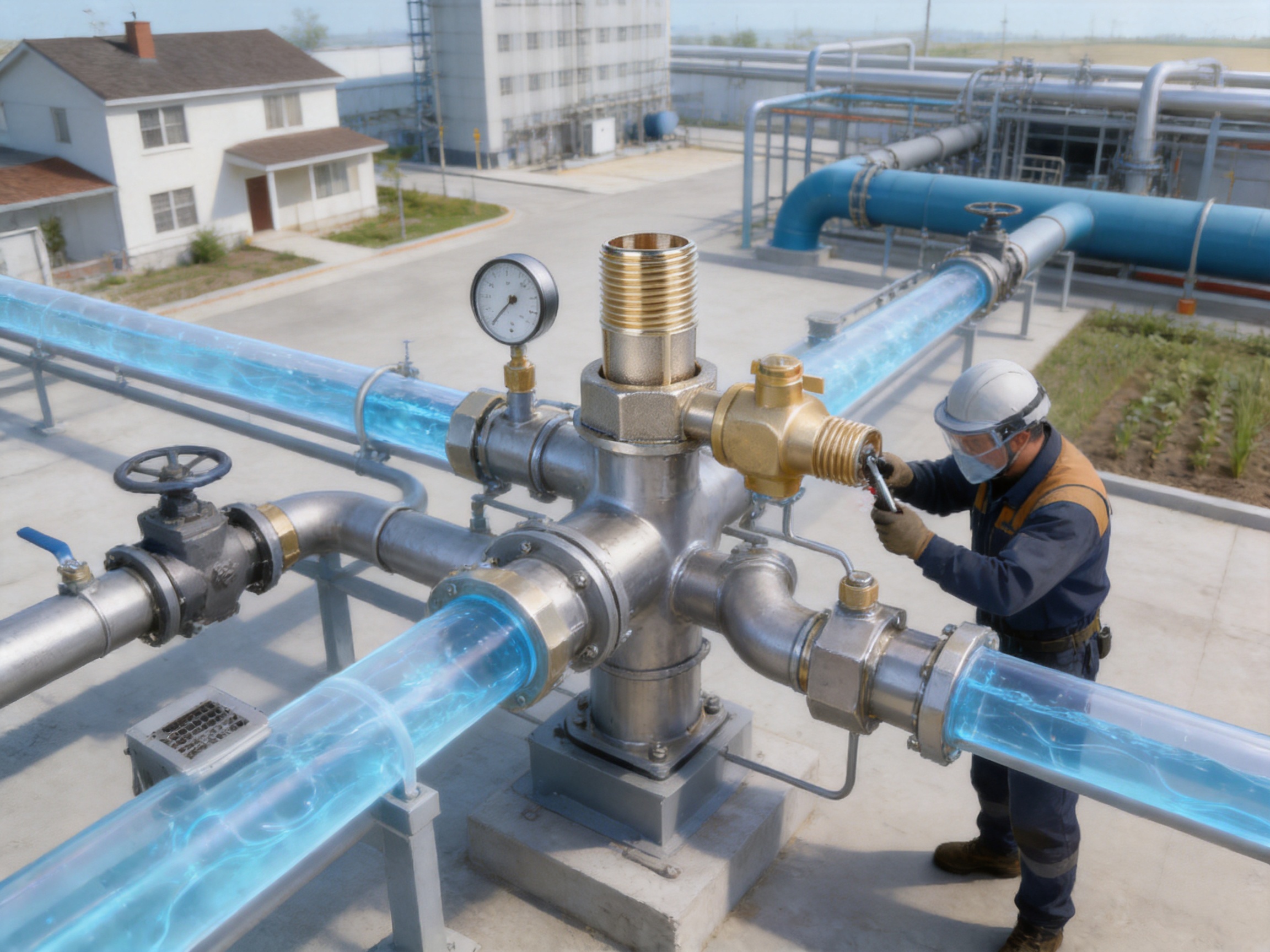
Pipe fittings are essential components in every modern piping system. They connect pipes, change flow direction, adjust pipe diameter, create branch lines, provide access for maintenance, and support the safe movement of gases, water, oil, and other fluids. Although fittings are often smaller than valves and piping sections, their performance has a direct effect on the reliability, safety, and service life of an entire installation.
High-quality pipe fittings must do more than simply join two pipes. They must maintain dimensional accuracy, provide dependable sealing, tolerate pressure and temperature changes, resist corrosion, withstand mechanical stress, and remain stable during years of operation. A fitting with poor thread quality, uneven wall thickness, or insufficient material strength can cause leakage, vibration, pressure loss, or unexpected system failure.
Ningbo Yunhua Valve Co., Ltd. develops and manufactures pipe fittings as part of its broader portfolio of gas and fluid valves, water supply valves, and hardware accessories. With a professional precision machining workshop, automated assembly lines, and dedicated testing facilities, the company combines manufacturing efficiency with quality control. Its production capabilities support both standard product supply and customized solutions for different piping requirements.
This article examines the structure, applications, material considerations, manufacturing process, quality advantages, and selection principles of modern pipe fittings. It also explains how precision production and systematic testing can help users achieve safer and more efficient piping systems.
Understanding the Function of Pipe Fittings
Pipe fittings are mechanical components used to connect, control, support, or terminate piping. They are installed in residential plumbing, commercial buildings, industrial facilities, agricultural irrigation systems, gas distribution networks, water treatment plants, heating systems, and many other applications.
The most basic purpose of a fitting is to create a continuous flow path between pipes. However, piping layouts rarely consist of straight lines only. Pipes must pass around equipment, change elevation, divide into multiple branches, transition between different diameters, or connect with valves and instruments. Fittings provide the geometry required to build these systems while maintaining mechanical integrity.
Common types include elbows, tees, crosses, couplings, reducers, adapters, nipples, caps, plugs, unions, and threaded connectors. Some fittings are designed for permanent connection, while others allow disassembly for inspection or maintenance. Depending on the application, a fitting may use threaded, socket, compression, flared, push-fit, welded, or other connection methods.
In fluid-control systems, pipe fittings work together with products such as threaded globe valves, forged steel valves, and brass gas ball valves. A valve may regulate, isolate, or redirect flow, but its effectiveness depends on the connected fittings. The complete assembly must have compatible dimensions, pressure ratings, materials, and sealing performance.
Main Types of Pipe Fittings
Elbows
Elbows change the direction of a pipe run. The most common configurations are 45-degree and 90-degree elbows, although special angles can be produced for specific installation requirements. Long-radius elbows generally provide smoother flow and lower pressure loss, while compact elbows are useful where installation space is limited.
Elbows are widely used in water supply, compressed air, gas distribution, heating, and industrial process lines. Their internal surfaces should be smooth and free from burrs because rough or irregular passages can increase turbulence, create pressure loss, and collect contaminants.
Tees and Cross Fittings
A tee fitting creates a branch connection from a main pipe. Equal tees have three openings of the same nominal size, while reducing tees connect a smaller branch pipe to a larger main line. Cross fittings provide four connection points and are used when flow must be distributed in multiple directions.
Branch fittings require special attention to wall thickness and structural strength. The intersection of several flow paths creates concentrated mechanical and hydraulic stresses. Properly manufactured tees and crosses should have accurate branch alignment, consistent geometry, and strong connection areas.
Couplings and Unions
Couplings join two pipes in a straight line. They are available in full-size and reducing designs. A union also joins two pipes but allows the connection to be separated without rotating the entire pipe assembly. This feature is especially useful near valves, pumps, filters, meters, and other equipment that may require regular servicing.
For threaded applications, the accuracy of the internal and external threads is critical. Threads that are too loose may leak, while threads that are too tight may become damaged during installation. A precision-manufactured coupling or union provides consistent engagement and supports reliable sealing with suitable thread sealant or gasket materials.
Reducers and Adapters
Reducers connect pipes of different diameters. A concentric reducer keeps the connected pipes aligned along the same centerline, while an eccentric reducer shifts the centerline to help prevent air pockets or drainage problems in certain systems.
Adapters allow different connection standards or pipe materials to be joined. For example, an adapter may connect a threaded metal fitting to another type of pipe connection. Correct dimensional compatibility is essential because even a small mismatch can lead to poor engagement, leakage, or excessive installation force.
Caps and Plugs
Caps close the end of a pipe externally, while plugs close an opening internally. They may be used for temporary isolation, system testing, future expansion, or permanent termination. Removable plugs are particularly useful during maintenance and pressure testing.
End fittings must provide dependable sealing under the expected pressure and temperature conditions. They should also be selected according to the fluid being handled, since some fluids may attack certain metals, elastomers, coatings, or sealing compounds.
Nipples and Threaded Connectors
Nipples are short pipe sections with threaded ends or other connection features. They are commonly used to connect valves, fittings, gauges, and equipment in compact installations. Threaded connectors are valued for their convenient installation and disassembly, especially in small and medium-sized piping systems.
Thread quality, thread length, concentricity, and surface finish all contribute to performance. Automated or precision-controlled machining helps ensure that each connector meets the required dimensional specifications.
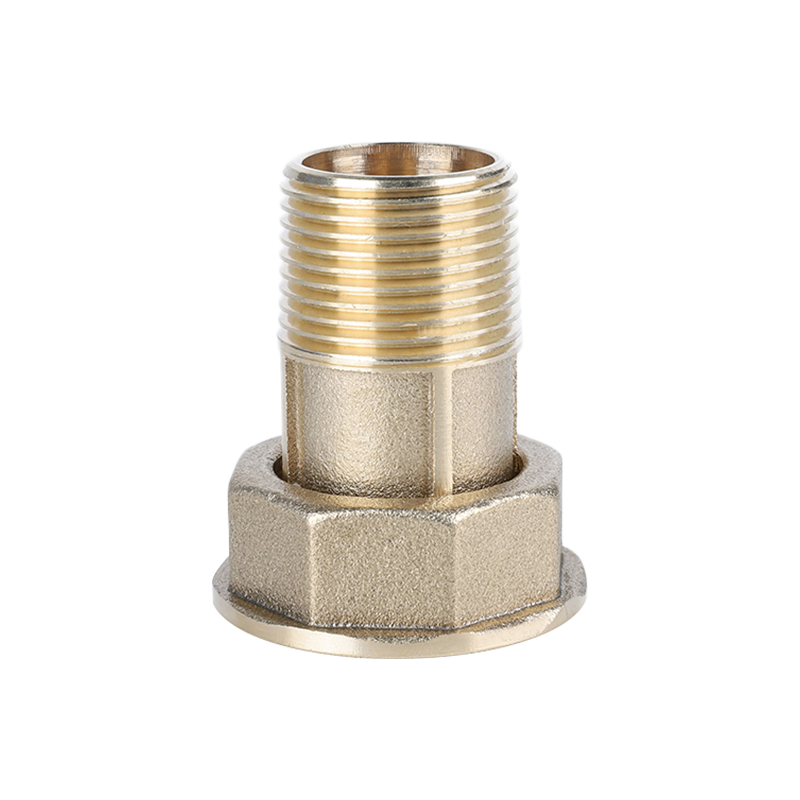
Pipe Fittings
Materials Used in Pipe Fittings
The material selected for a pipe fitting must match the service environment. Important factors include fluid type, pressure, temperature, corrosion risk, mechanical loading, installation method, and expected operating life.
Brass
Brass is widely used for water, air, gas, and general-purpose fluid connections. It offers good machinability, reasonable corrosion resistance, and stable dimensional performance. Brass fittings are also suitable for many residential and commercial plumbing applications because they can be manufactured with accurate threads and smooth sealing surfaces.
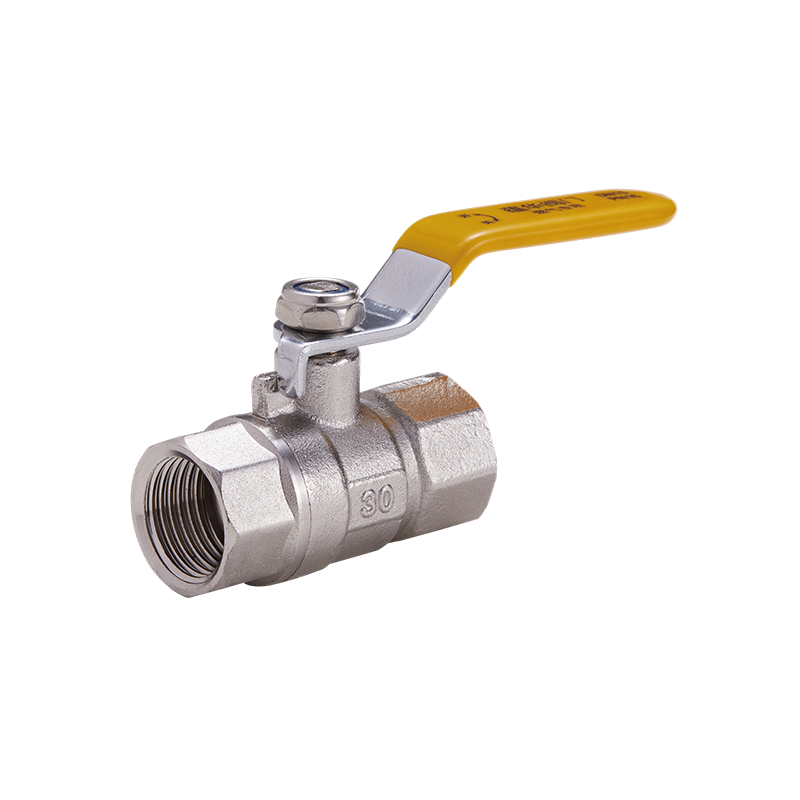
Brass gas fittings must be produced and tested carefully because gas systems require dependable leak resistance. Material composition, machining accuracy, sealing design, and inspection procedures are all important. A brass gas ball valve assembly, for example, depends on the compatibility and precision of the connected fittings to achieve secure isolation.
Carbon Steel and Forged Steel
Carbon steel and forged steel fittings are selected for applications requiring high strength and pressure resistance. Forging can produce a dense and robust structure, making forged fittings suitable for demanding industrial service. They are commonly used in oil and gas, chemical processing, power generation, hydraulic systems, and high-pressure piping.
Forged steel valves and fittings often operate under severe conditions. Their connected components must be capable of handling mechanical loads, thermal expansion, vibration, and pressure fluctuations. Surface protection or suitable material selection may be necessary when corrosion exposure is significant.
Stainless Steel
Stainless steel fittings provide strong resistance to corrosion and are often used in food processing, pharmaceutical production, water treatment, chemical handling, and outdoor environments. Different stainless steel grades offer different balances of corrosion resistance, strength, temperature capability, and cost.
When selecting stainless steel fittings, users should consider chloride exposure, acidic or alkaline fluids, cleaning chemicals, and elevated temperatures. The fitting should be manufactured and finished in a way that preserves the intended corrosion resistance.
Other Engineering Materials
Depending on the application, fittings may also be made from ductile iron, cast iron, copper, aluminum, plastics, reinforced polymers, or specialized alloys. Nonmetallic fittings can offer low weight and strong chemical resistance, while metallic fittings generally provide greater mechanical strength and temperature tolerance.
Material selection should never be based on price alone. The total cost of ownership includes installation, maintenance, leakage risk, downtime, replacement frequency, and safety requirements. A properly selected fitting can reduce long-term operating expenses even when its initial purchase price is higher.
Connection Methods and Sealing Performance
Threaded Connections
Threaded fittings are popular because they are relatively easy to install and remove. They are suitable for many low- and medium-pressure systems, particularly where pipe sizes are moderate and frequent maintenance may be required.
Threaded connections require correct thread standards and careful installation. The male and female threads must match in profile, pitch, diameter, and taper. Excessive tightening can crack a fitting, deform the threads, or damage a valve body. Insufficient tightening can produce leakage or loosening during vibration.
Thread sealant, sealing tape, or suitable pipe compound may be used according to the application. The sealing material should be compatible with the fluid and temperature. For gas service, only approved sealing products and installation procedures should be used.
Compression Connections
Compression fittings use a nut and ferrule to create a mechanical seal around the pipe. They are useful where welding or threading is impractical. Correct tube preparation and tightening are essential because an improperly seated ferrule may leak or become displaced under pressure.
Flanged Connections
Flanges permit relatively easy assembly and disassembly of larger pipe systems. A gasket is compressed between two flange faces to create the seal. Flanged systems are commonly used around pumps, valves, tanks, and equipment that must be removed for maintenance.
Flange alignment, gasket selection, bolt tightening sequence, and surface condition all influence performance. Uneven tightening can create localized stress and an incomplete seal.
Welded Connections
Welded fittings can provide strong and permanent connections for demanding applications. They are frequently used in industrial piping, high-temperature systems, and installations where leakage must be minimized. Welding requires qualified procedures, skilled operators, and appropriate inspection.
Sealing Surfaces
A fitting’s sealing surface must be smooth, accurately formed, and free from scratches, dents, burrs, or embedded contaminants. Precision machining is particularly important for threaded connectors, valve interfaces, union seats, and gasket contact areas.
Reliable sealing is a combination of fitting design, material quality, dimensional control, installation technique, and service compatibility. No single feature can compensate for weaknesses in the others.
Advantages of Precision-Manufactured Pipe Fittings
Consistent Dimensional Accuracy
Precision machining helps fittings maintain consistent diameters, thread profiles, lengths, and connection positions. This consistency improves interchangeability and makes installation faster. Contractors can work with fewer adjustments, less rework, and lower risk of connection damage.
Accurate dimensions are also important when fittings are installed in compact assemblies. Small deviations can accumulate across several components and create alignment problems. A well-controlled manufacturing process reduces these dimensional variations.
Improved Leak Resistance
Leakage is one of the most common problems in piping systems. It can result from poor threads, uneven sealing faces, casting defects, cracks, improper material selection, or installation errors. High-quality fittings reduce these risks through controlled machining, careful assembly, and pressure or leak testing.
Improved leak resistance protects equipment, reduces fluid loss, limits environmental impact, and enhances workplace safety. In gas applications, leakage control is especially important because flammable or hazardous gases require strict containment.
Reliable Mechanical Strength
Pipe fittings experience more than internal pressure. They may also be exposed to vibration, thermal expansion, external loads, impact, and repeated installation stress. Appropriate materials and sound manufacturing practices provide the strength required to maintain connection integrity.
Fittings produced with controlled material preparation and accurate processing are less likely to contain harmful defects. For high-pressure or safety-critical service, users should confirm that the product is suitable for the required pressure class and applicable standards.
Smoother Internal Flow
Internal burrs, abrupt transitions, and rough surfaces can disturb fluid flow. They may increase turbulence, pressure loss, noise, and the accumulation of particles. Smooth internal passages contribute to more efficient flow and can support the performance of connected valves and equipment.
Longer Service Life
Durable fittings reduce the frequency of replacement and maintenance. Their service life depends on material compatibility, corrosion protection, pressure control, installation quality, and operating conditions. Precision manufacturing supports durability by reducing geometric weaknesses and ensuring more consistent wall thickness and connection quality.
Better Compatibility with Valves and Hardware
A complete fluid-control system may include ball valves, globe valves, check valves, water supply valves, meters, filters, pumps, and many types of hardware accessories. Accurate pipe fittings help these components connect properly and operate as intended.
For example, a threaded globe valve requires secure and accurately matched threaded connections. A forged steel valve installation may require fittings with comparable strength and pressure capability. A brass gas ball valve must be connected with components that support gas-tight sealing and suitable corrosion resistance.
Manufacturing Process for High-Quality Pipe Fittings
Product Design and Engineering
Manufacturing begins with product design. Engineers determine the fitting’s geometry, nominal size, connection type, material, pressure requirements, surface finish, and intended application. Computer-aided design can help evaluate dimensions, identify potential interference, and standardize product families.
Design must consider both the fitting itself and the way it will be used in a complete piping system. Wall thickness, corner radius, thread length, flow path, tool access, and assembly clearance all influence practical performance.
Material Preparation
Incoming raw materials should be identified, inspected, and stored properly. Bars, forgings, castings, tubes, and other blanks must have suitable dimensions and material characteristics. Preventing material mix-ups is important because visually similar metals may have very different pressure, corrosion, or temperature capabilities.
Material preparation may include cutting, forging, casting, heat treatment, deburring, and preliminary inspection. The chosen process depends on the fitting design and required mechanical properties.
CNC Precision Machining
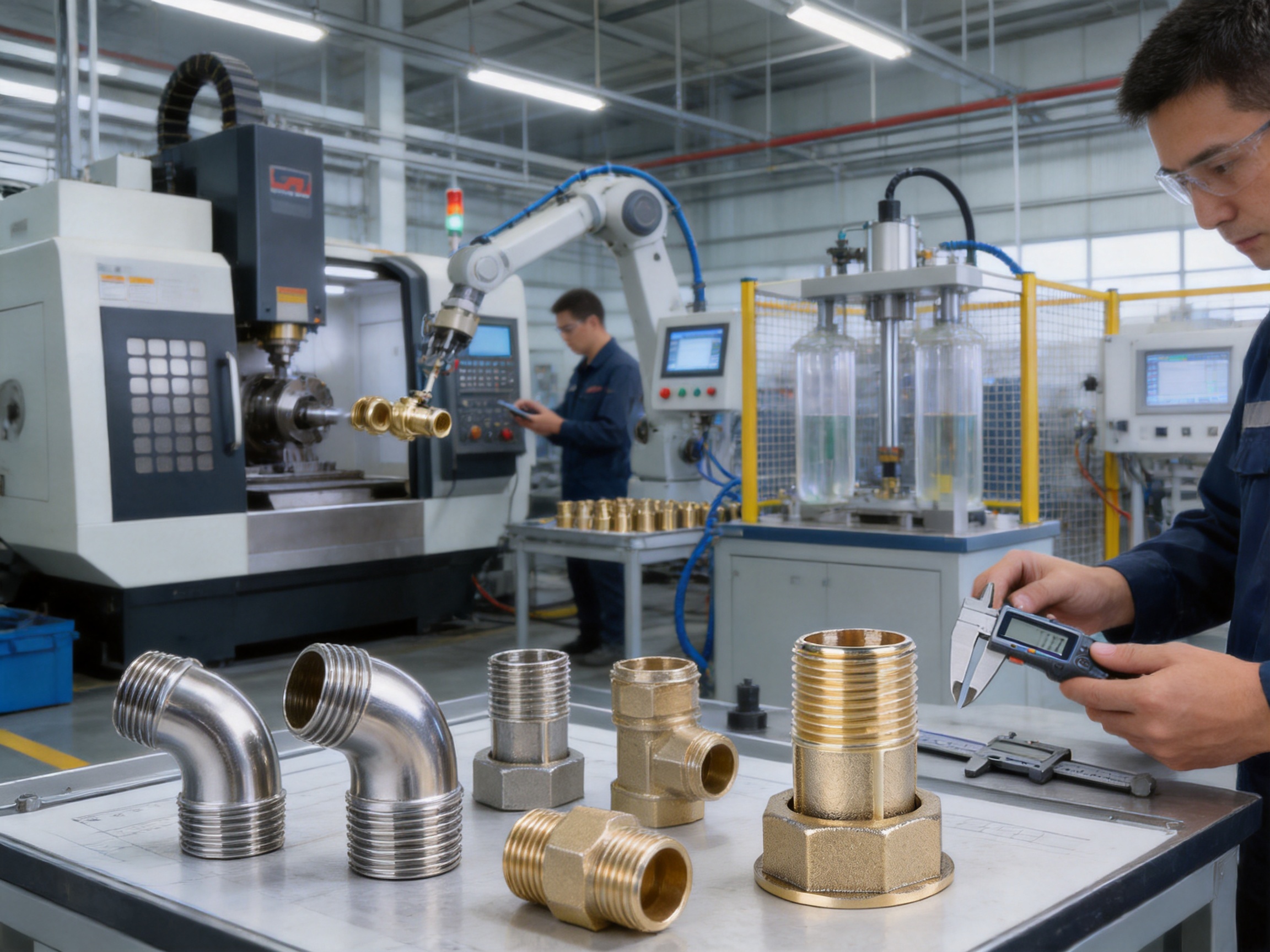
Computer numerical control machining is an important part of modern fitting production. CNC lathes, machining centers, drilling equipment, and thread-cutting tools can produce repeatable dimensions with efficient cycle times.
CNC equipment supports accurate turning, boring, drilling, tapping, threading, grooving, and facing. Automated tool paths reduce variation between batches and allow complex geometries to be produced consistently. Tool condition, cutting parameters, coolant management, and workpiece positioning must be controlled to maintain quality.
Ningbo Yunhua Valve Co., Ltd. has established a professional precision machining workshop equipped with advanced domestic and international CNC machine tools. This production foundation supports the manufacture of valves and hardware accessories, including pipe fittings that require stable dimensional accuracy and repeatable connection quality.
Deburring and Surface Finishing
After machining, sharp edges and burrs must be removed. Deburring improves safety during handling, protects seals, and prevents loose particles from entering the piping system. Surface finishing may include polishing, cleaning, passivation, plating, coating, or other treatments, depending on the material and service environment.
Good surface finishing also improves the appearance of the product and makes it easier to inspect. More importantly, it can support corrosion resistance and sealing performance.
Assembly
Some fittings are supplied as single components, while others are assembled with nuts, ferrules, gaskets, seals, handles, or other parts. Assembly should be performed according to controlled procedures so that components are installed in the correct orientation and with appropriate force.
The company operates an automated assembly line designed to improve consistency and production efficiency. Automation can reduce variation caused by repetitive manual operations while allowing production personnel to focus on process supervision, inspection, and exception handling.
Testing and Inspection
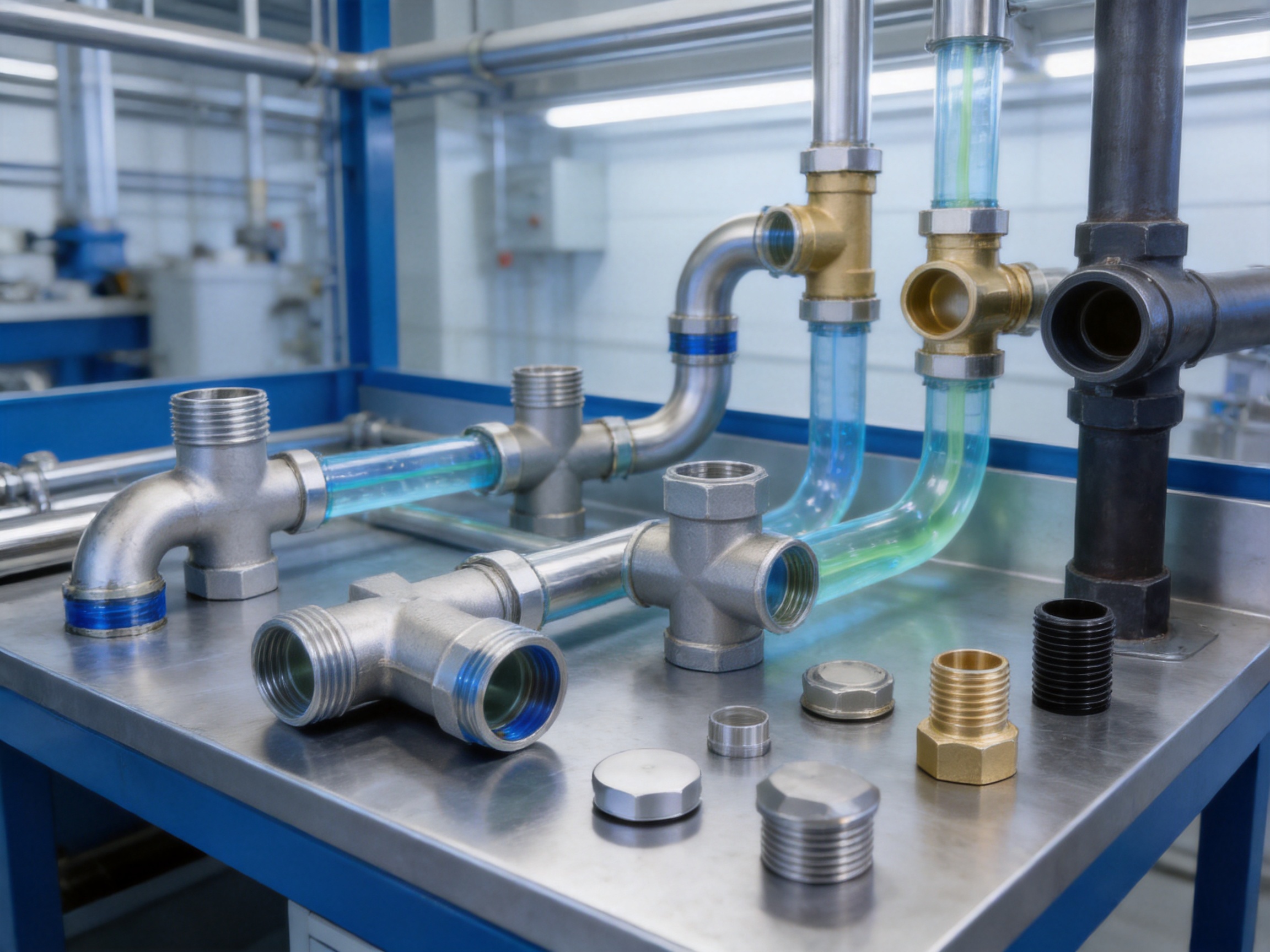
Testing verifies whether a fitting is capable of meeting its intended function. Depending on the product, inspections may include dimensional measurement, visual examination, thread gauging, material verification, pressure testing, air testing, leakage testing, torque testing, and surface inspection.
A dedicated testing workshop allows quality personnel to evaluate products under controlled conditions. Testing equipment should be calibrated and maintained so that results are reliable and traceable. Products that fail inspection should be identified, isolated, analyzed, and corrected through an appropriate quality procedure.
Quality Management and Production Strength
A manufacturer’s quality strength is determined not only by individual machines but also by the complete production system. This includes engineering, procurement, machining, assembly, testing, warehousing, packaging, documentation, and customer service.
Ningbo Yunhua Valve Co., Ltd. has spent more than ten years developing its management system and professional management team. The company’s manufacturing base covers approximately 20,000 square meters and includes precision machining, automated assembly, and testing facilities. These resources support the production of valves and hardware accessories at an annual capacity of approximately 2 million sets of valves and 10 million sets of hardware accessories.
Large production capacity can provide several practical advantages. It supports stable supply for distributors and project contractors, improves production scheduling, allows resources to be allocated efficiently, and helps the manufacturer respond to recurring orders. However, capacity must be combined with process control. High output is valuable only when product consistency is maintained.
A systematic quality approach should include clear specifications, controlled drawings, approved materials, standard operating procedures, inspection plans, equipment maintenance, staff training, and records management. These elements help reduce variation and make it easier to identify the cause of any nonconformity.
For customers, a reliable manufacturing system can simplify supplier management. Instead of evaluating every shipment as an isolated purchase, buyers can build a long-term relationship with a supplier that understands their product requirements, packaging needs, inspection expectations, and delivery schedule.
Applications of Pipe Fittings
Residential Plumbing
Pipe fittings are used in cold-water supply, hot-water systems, drainage, heating, and household gas installations. Residential products must be compact, easy to install, resistant to corrosion, and compatible with commonly used pipe sizes and connection standards.
Reliable fittings help prevent water damage, reduce maintenance, and support stable pressure throughout the home. In gas installations, fitting selection and installation must comply with applicable local safety requirements.
Commercial Buildings
Office buildings, hotels, schools, hospitals, and shopping centers require extensive water, heating, cooling, fire protection, and utility piping. Commercial systems often have complex layouts and many connection points, making fitting quality essential.
Commercial projects also place strong emphasis on installation speed and maintainability. Unions, adapters, and accurately manufactured threaded fittings can reduce assembly time and make future service more convenient.
Gas Distribution
Gas systems require components with dependable sealing, suitable material compatibility, and adequate pressure resistance. Brass fittings and brass gas ball valve assemblies are widely used in many gas applications, provided that the products are correctly specified and installed.
Gas fittings should be protected from impact, excessive vibration, unauthorized modification, and corrosion. Leak testing should be conducted according to the applicable installation standard before the system is placed into operation.
Water Supply and Treatment
Water supply systems use fittings to connect pumps, tanks, filters, meters, valves, and distribution lines. Water treatment facilities may handle clean water, wastewater, chemicals, or sludge, and each service requires suitable material and sealing choices.
In drinking-water applications, materials and surface treatments should be selected according to relevant health and safety requirements. Fittings should not introduce harmful substances into the water or create areas where contamination can accumulate.
Industrial Processing
Industrial facilities rely on pipe fittings for compressed air, hydraulic oil, steam, cooling water, chemicals, fuels, and process fluids. These systems may operate at elevated pressure or temperature and may experience vibration, thermal cycling, or aggressive chemical exposure.
Forged steel fittings and valves are often considered for demanding service because of their strength. However, the complete piping system must be evaluated, including pipe material, gasket type, bolting, welding method, pressure rating, and inspection requirements.
Agricultural Irrigation
Irrigation systems use fittings to divide water flow, connect pumps, change pipe direction, and supply different field sections. Ease of installation, resistance to outdoor exposure, and simple maintenance are important considerations.
Fittings for agricultural systems should be selected according to water quality, ultraviolet exposure, soil conditions, operating pressure, and seasonal temperature changes.
Pipe Fittings Compared with Competing Products
Competition in the pipe fitting market is based on more than unit price. Buyers compare dimensional consistency, material reliability, sealing performance, delivery capability, customization support, testing, packaging, and after-sales service.
Consistency Across Production Batches
Some low-cost products may perform acceptably in one shipment but show significant variation in another. Inconsistent dimensions can increase installation time and create problems when replacement parts are needed. A controlled CNC-based process helps manufacturers produce more uniform batches.
Manufacturing Integration
Suppliers that only purchase finished components may have limited control over machining accuracy and process changes. An integrated manufacturer with its own precision workshop, assembly line, and testing area can respond more effectively to quality issues and product improvement requirements.
Customization Capability
Many projects require special sizes, thread standards, materials, surface treatments, markings, packaging, or combinations of fittings and valves. A manufacturer with engineering and production resources can evaluate these requirements more efficiently than a trading company with no direct manufacturing control.
Production Capacity and Delivery
Large-scale production capability can be a competitive advantage for importers, distributors, and project suppliers. It supports repeat orders and reduces the risk of supply interruptions. Capacity planning is particularly important when customers need complete product families rather than a single fitting size.
Application Knowledge
A supplier that manufactures both pipe fittings and fluid-control valves can better understand how these products work together. This knowledge supports more practical recommendations for threaded globe valves, forged steel valves, brass gas ball valves, water supply valves, and related hardware accessories.
| Evaluation Factor | Importance to Buyers | Quality Advantage of a Controlled Manufacturer |
|---|---|---|
| Dimensional accuracy | Supports easy installation and interchangeability | Precision CNC machining and inspection reduce variation |
| Thread quality | Helps prevent leakage and connection damage | Controlled tooling and thread gauging improve consistency |
| Material reliability | Determines strength and corrosion resistance | Material identification and process control reduce mix-ups |
| Pressure performance | Protects the system during operation | Pressure and leak testing verify product function |
| Surface finish | Improves sealing and corrosion resistance | Controlled deburring and finishing create stable surfaces |
| Production capacity | Supports regular supply and project orders | Dedicated workshops and production planning improve delivery |
| Customization | Meets special technical or packaging requirements | Engineering and manufacturing resources support tailored products |
| After-sales support | Helps resolve installation and product questions | Technical knowledge from integrated manufacturing improves assistance |
How to Select the Right Pipe Fittings
Identify the Fluid
Begin by identifying the fluid or gas that will pass through the fitting. Water, natural gas, compressed air, oil, steam, chemicals, and wastewater have different compatibility requirements. The fluid may attack certain metals, seals, coatings, or lubricants.
Confirm Pressure and Temperature
Determine the normal operating pressure, maximum allowable pressure, operating temperature, and possible pressure surges. A fitting should not be selected only according to the pipe’s nominal size. Its pressure and temperature capability must be suitable for the actual service conditions.
Check Size and Connection Standard
Confirm nominal diameter, outside diameter, thread standard, pitch, taper, flange dimensions, and connection type. If components come from different suppliers, verify compatibility before placing an order.
Consider Installation Conditions
Available space, tool access, maintenance frequency, vibration, pipe movement, and alignment all affect fitting selection. A union may be preferable where equipment must be removed regularly. A compact elbow may be required in a restricted area, while a long-radius elbow may be better where flow efficiency is more important.
Evaluate Corrosion Exposure
Consider internal fluid corrosion, external humidity, salt spray, soil contact, cleaning chemicals, and atmospheric exposure. Material, coating, plating, and surface treatment should be selected accordingly.
Review Applicable Standards
Different regions and industries may require specific standards for dimensions, materials, pressure ratings, gas service, drinking water, or fire protection. Buyers should identify the relevant requirements before production begins and request suitable technical documentation when necessary.
Choose a Dependable Supplier
Supplier evaluation should include manufacturing facilities, inspection procedures, production capacity, technical communication, customization experience, packaging, delivery performance, and customer support. A factory visit, sample approval, or third-party inspection may be appropriate for large or safety-critical projects.
Installation and Maintenance Recommendations
Even the best pipe fitting can fail if installed incorrectly. Before installation, inspect the fitting for damage, contamination, incorrect dimensions, or visible defects. Confirm that the fitting is the correct material and connection type for the system.
Clean the pipe ends and remove burrs or debris. For threaded connections, ensure that the threads are undamaged and properly aligned. Apply only a compatible sealant and avoid placing excessive sealant where it could enter the flow path or interfere with valves and instruments.
Tighten fittings according to suitable procedures. Do not use excessive force to compensate for mismatched threads or poor alignment. Pipe supports should be installed so that the fitting is not carrying unnecessary weight or bending load.
After installation, conduct the required pressure or leak test before placing the system into service. Inspect the connection during operation, particularly after thermal cycling, vibration, or maintenance work.
Routine maintenance may include visual inspection, corrosion checks, leakage monitoring, torque verification, cleaning, and replacement of worn seals. If a fitting has been exposed to severe corrosion, impact, overpressure, or chemical attack, it should be evaluated before continued use.
Environmental and Operational Benefits
Reliable pipe fittings support environmental performance by reducing leakage and extending product life. A leaking water system wastes treated water and increases pumping energy. A leaking gas or chemical system may create safety risks and environmental contamination.
Durable fittings also reduce waste associated with frequent replacement. Longer service life means fewer raw materials, packaging materials, transportation cycles, and discarded components. Precision production can further reduce manufacturing waste by improving material utilization and lowering the number of rejected parts.
Automation contributes to efficient production by improving repeatability and reducing unnecessary rework. When combined with responsible material management, equipment maintenance, and process monitoring, automated manufacturing can support both economic and environmental objectives.
Customization and OEM Supply
Different customers may require different sizes, thread standards, finishes, markings, packaging methods, and product combinations. Customization can be important for distributors that serve a particular regional standard or for engineering contractors working on specialized systems.
OEM and private-label supply may include product labeling, carton design, barcode management, documentation, and shipment configuration. A capable manufacturer should confirm technical requirements before production and provide samples or drawings when needed.
Customization should preserve essential performance characteristics. Changes to wall thickness, material, sealing design, or connection geometry may influence pressure capability and should be reviewed by qualified technical personnel. Appearance-related changes and functional changes should be treated differently, with functional modifications receiving appropriate engineering validation.
Ningbo Yunhua Valve Co., Ltd. combines valve and hardware accessory production with a professional management team and automated manufacturing resources. This combination can support customers seeking coordinated sourcing of pipe fittings, water supply valves, gas valves, fluid-control products, and related accessories.
Frequently Asked Questions
What are pipe fittings used for?
Pipe fittings connect pipes, change flow direction, create branches, reduce or increase pipe size, terminate lines, and connect piping to valves or equipment. They are used in plumbing, gas, water treatment, industrial processing, irrigation, heating, and many other systems.
How do I choose the correct fitting material?
Choose the material according to the fluid, pressure, temperature, corrosion exposure, mechanical loads, and applicable regulations. Brass is common for many water and gas applications, while forged steel may be suitable for higher-strength industrial service. Stainless steel is often selected for enhanced corrosion resistance.
Are threaded fittings suitable for gas systems?
Threaded fittings may be suitable for gas systems when they are specifically designed, rated, manufactured, and approved for the intended gas service. Correct thread compatibility, approved sealant, proper installation, and leak testing are essential. Local codes and safety requirements must always be followed.
What is the difference between a coupling and a union?
A coupling joins two pipes, usually in a straight line. A union also joins two pipes but is designed to allow easier disassembly. Unions are useful near valves, meters, pumps, filters, and other components that may require maintenance.
Why is CNC machining important for pipe fittings?
CNC machining provides repeatable control over dimensions, threads, bores, grooves, and sealing surfaces. It helps reduce batch variation, improve interchangeability, increase installation efficiency, and support reliable sealing performance.
What tests should be performed on pipe fittings?
Testing depends on the product and application. Common checks include visual inspection, dimensional measurement, thread gauging, material verification, pressure testing, air testing, leakage testing, torque testing, and surface inspection.
Can pipe fittings be customized?
Many manufacturers can customize dimensions, materials, connection standards, surface treatments, markings, packaging, and product combinations. Customized designs should be reviewed to ensure that pressure, sealing, strength, and regulatory requirements remain satisfied.
How can leakage be prevented?
Use fittings with accurate dimensions and suitable materials, confirm thread or flange compatibility, prepare pipe ends correctly, apply compatible sealant, avoid over-tightening, provide proper pipe support, and perform pressure or leak testing before operation.
What makes one pipe fitting manufacturer better than another?
Important factors include manufacturing control, raw material management, CNC machining capability, assembly consistency, testing resources, production capacity, technical support, customization ability, documentation, and delivery reliability. A manufacturer with integrated facilities can often provide better control than a supplier that only resells finished products.
How do fittings work with valves?
Fittings provide the mechanical and fluid connection between valves and the rest of the piping system. They must match the valve’s connection type, size, pressure rating, material compatibility, and service requirements. Accurate fittings help valves operate without leakage, misalignment, or excessive stress.
Why Manufacturing Capability Matters
Pipe fittings are small components, but their influence on system performance is substantial. A high-quality fitting supports safe assembly, stable pressure, efficient flow, and long service life. A poorly made fitting can undermine the performance of an otherwise advanced valve or pipe system.
Manufacturing capability matters because quality is created through repeated control of many details. Precision machining establishes accurate geometry. Automated assembly improves consistency. Testing confirms performance. Professional management coordinates materials, equipment, personnel, documentation, and customer requirements.
Ningbo Yunhua Valve Co., Ltd. has developed an integrated production base for gas and fluid valves, water supply valves, and hardware accessories. Its precision machining workshop, automated assembly line, and testing workshop provide a strong foundation for producing dependable pipe fittings and related components. The company’s production capacity and experience also support the requirements of distributors, contractors, equipment manufacturers, and project suppliers.
For buyers, the best results come from evaluating the complete supply relationship rather than comparing unit price alone. Technical compatibility, quality stability, delivery performance, customization support, and long-term service all contribute to the real value of a pipe fitting.
Conclusion
Pipe fittings are fundamental to the construction of safe and efficient piping systems. They provide the connections, transitions, branches, and terminations required to move gases and fluids through residential, commercial, agricultural, and industrial installations.
The best fittings combine suitable material selection, accurate dimensions, dependable threads or sealing surfaces, strong mechanical construction, smooth internal passages, and verified pressure performance. Their quality depends heavily on the manufacturing process, from engineering and material preparation to CNC machining, deburring, assembly, inspection, and testing.
Compared with inconsistent low-cost alternatives, precision-manufactured fittings offer improved interchangeability, better leak resistance, more reliable mechanical strength, and longer service life. These advantages become particularly important when fittings are used with threaded globe valves, forged steel valves, brass gas ball valves, water supply valves, and other fluid-control equipment.
With a 20,000-square-meter production base, advanced CNC equipment, automated assembly resources, dedicated testing facilities, and substantial annual output, Ningbo Yunhua Valve Co., Ltd. is positioned to supply pipe fittings and related hardware accessories for diverse market requirements. Its focus on quality, manufacturing improvement, and fluid-control solutions supports the broader goal of creating safer and more dependable piping systems.
References
1. General principles of industrial piping design, connection methods, and component selection.
2. Technical guidance on metallic pipe fittings, threaded connections, flange assemblies, and pressure testing.
3. Engineering practices for fluid-control valves, gas piping components, and water supply systems.
4. Manufacturing principles for computer numerical control machining, automated assembly, and dimensional inspection.
5. Industrial quality-management practices for material traceability, process control, product testing, and supplier evaluation.
6. General safety recommendations for the installation, testing, operation, and maintenance of gas and fluid piping systems.
Product: Pipe Fittings

Related Products
Related News
Contact Us
-

-
 +86-0574-63742169
-
 No.104-128, Cizhang East Road, Zhangqi Town, Cixi City, Ningbo, Zhejiang Province, China


Message Us Now !
