


 English
  русский
  عربى
عربى  Español
Brass Ball Valve with Integrated Base and F/M Threaded Connection
Content
- 1 Product Overview
- 2 Key Design Features
- 3 Advantages in Practical Installation
- 4 Comparison with Conventional Valve Arrangements
- 5 Application Scenarios
- 6 Manufacturing and Quality Strengths
- 7 Manufacturing Process from Material to Finished Valve
- 8 Installation Guidance
- 9 Operation and Maintenance
- 10 Why the Product Offers Competitive Value
- 11 Purchasing Considerations
- 12 Safety and Service Limitations
- 13 Frequently Asked Questions
- 13.1 What does F/M mean in the product name?
- 13.2 What is the purpose of the integrated base?
- 13.3 Is the valve intended for water or gas?
- 13.4 Can the valve be used for flow regulation?
- 13.5 What are the main advantages over a standard two-female ball valve?
- 13.6 Does the integrated base replace all pipe supports?
- 13.7 How should the valve be installed?
- 13.8 What manufacturing capabilities support this product?
- 13.9 What is the manufacturer’s production capacity?
- 13.10 How can leakage be prevented?
- 13.11 Can the valve be used in a confined equipment space?
- 13.12 What should be checked before bulk purchasing?
- 14 Conclusion
- 15 References
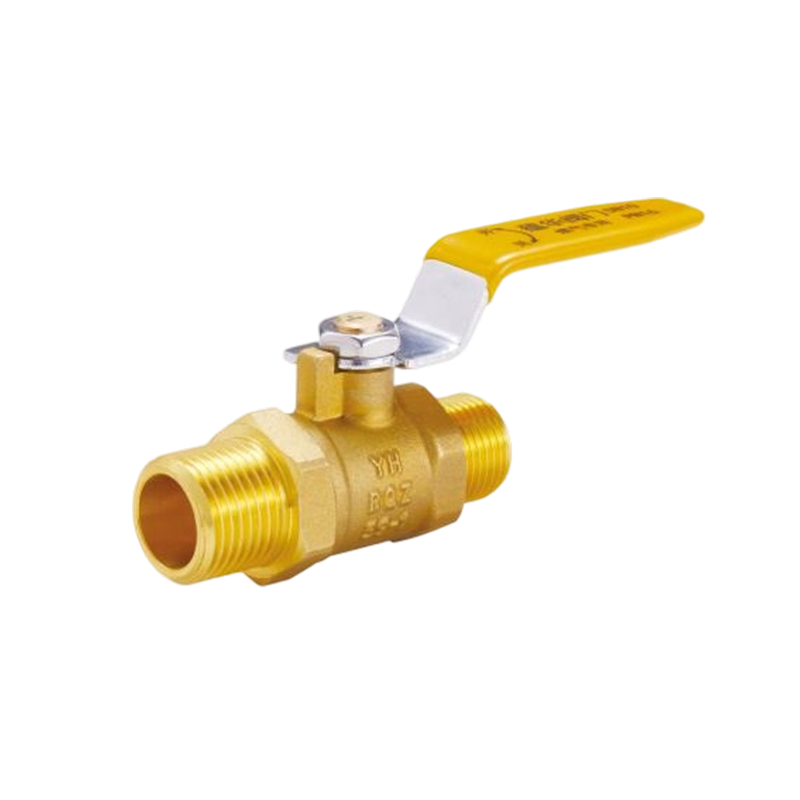
- 16 Product: YH-211 Brass Ball Valve with Base(F/M)
Modern fluid-control systems depend on components that are compact, dependable, easy to install, and capable of maintaining secure connections over many years of service. A brass ball valve with an integrated base and female/male threaded configuration addresses these requirements in one practical design. It combines the proven shutoff performance of a quarter-turn ball valve with the installation flexibility of mixed threading and the structural stability of a fixed mounting base.
The YH-211 Brass Ball Valve with Base (F/M) is designed for applications involving gas, tap water, and other compatible fluid systems. Its construction focuses on three important installation challenges: connecting pipes with different thread directions or configurations, preventing valve movement caused by vibration, and maintaining reliable sealing during repeated operation. These features make it suitable for residential, commercial, equipment-side, and light industrial piping layouts.
Manufactured by Ningbo Yunhua Valve Co., Ltd., the valve reflects the company’s specialization in gas and fluid valves, water supply valves, and hardware accessories. The manufacturer combines precision machining, automated assembly, and systematic testing to produce components for large-volume distribution and project-based supply. This article examines the valve’s design, application value, manufacturing strengths, and advantages compared with more conventional valve configurations.
Product Overview
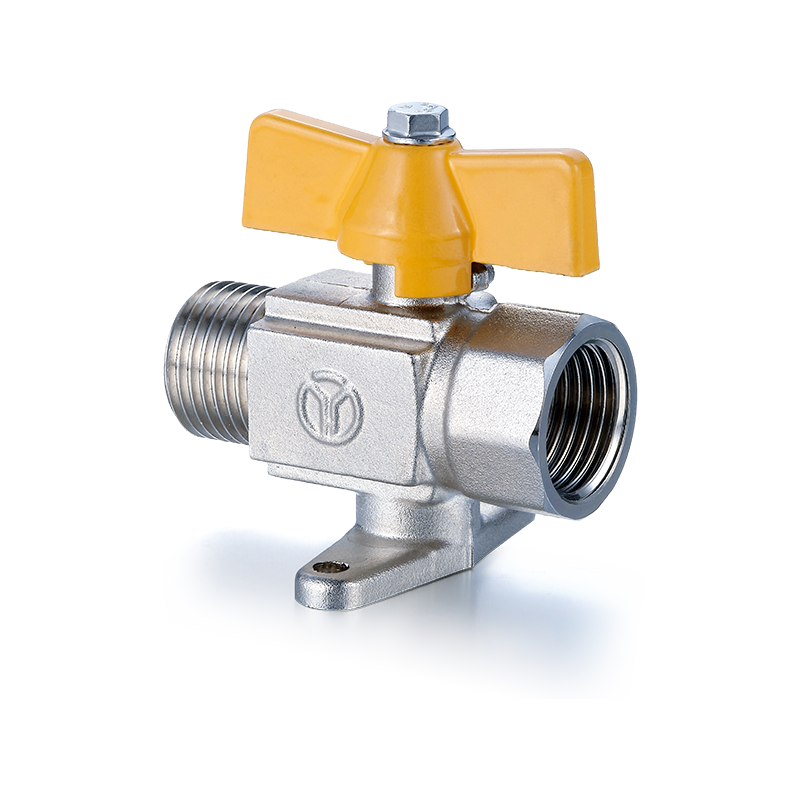
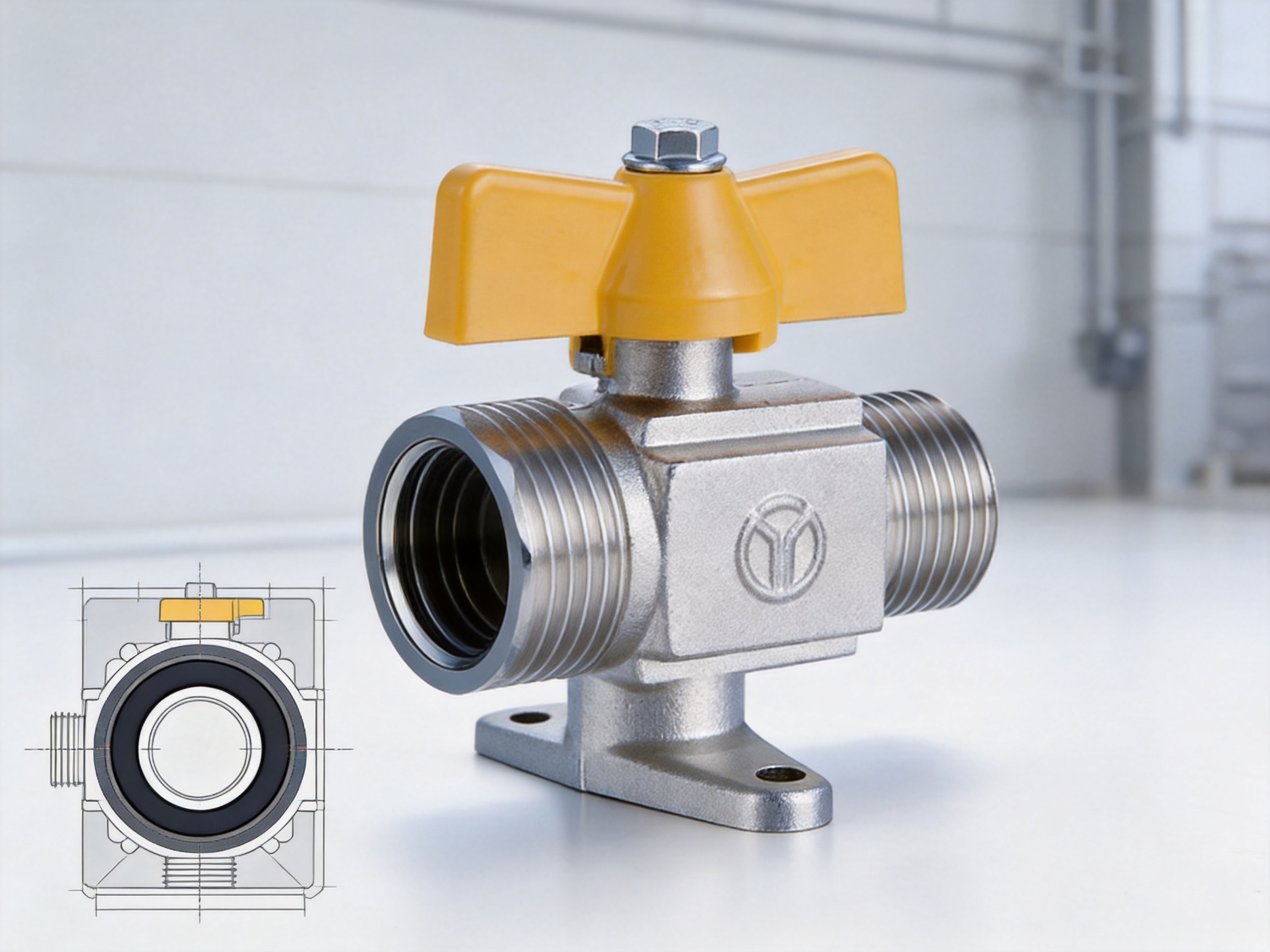
The YH-211 is a brass ball valve equipped with an integrated mounting base and a partial male/female threaded connection. One side of the valve uses a female thread, while the opposite side uses a male thread. This F/M structure allows installers to connect components with different connection requirements without relying on as many additional adapters, nipples, or transition fittings.
At the center of the valve is a rotating ball with a precision-machined passage. When the handle is aligned with the pipeline, the passage allows the medium to flow through. When the handle is turned approximately 90 degrees, the solid portion of the ball blocks the passage and shuts off the line. This quarter-turn operating principle provides fast control and a clear visual indication of the valve’s position.
The integrated base is formed as part of the valve body rather than being supplied as a separate clamp or bracket. It can be used to secure the valve to a wall, panel, equipment frame, or other suitable support. By reducing free movement in the installed assembly, the base helps limit stress on threaded joints and improves stability when the pipeline experiences vibration, pressure fluctuation, or repeated manual operation.
The valve uses brass as its principal body material. Brass is widely used in plumbing, gas-control, and hardware applications because it offers a useful balance of mechanical strength, corrosion resistance, machinability, and cost efficiency. It can be accurately formed and machined into compact valve bodies while supporting consistent thread production and reliable sealing surfaces.
Key Design Features
F/M Threaded Connection
The most distinctive feature of the valve is its mixed female/male threaded configuration. Conventional valves frequently use two female ports or two male ports. Although these arrangements are suitable for many standard installations, they may require supplementary fittings when the surrounding pipeline has a different connection pattern. Every additional fitting adds assembly time, increases the number of potential leakage points, and may make the finished installation longer or less compact.
The F/M design creates a direct transition between two connection types. The female end can receive a male-threaded pipe or fitting, while the male end can engage with a female-threaded pipe, socket, union, or equipment port. This flexibility is especially useful in branch connections, transition connections, replacement work, and equipment-side installations where the existing pipe layout is not completely standardized.
For maintenance teams, the mixed-thread arrangement can simplify the replacement of an existing valve. Instead of redesigning an entire short section of pipe, the installer may be able to remove the old component and connect the new valve using the existing upstream and downstream arrangements. Actual compatibility still depends on thread standard, nominal size, pressure rating, medium, and local installation requirements, but the basic configuration provides a practical starting point for efficient replacement.
Integrated Mounting Base
A valve is not only a flow-control device; it is also a mechanical component installed within a larger system. If a valve hangs unsupported between two pipes, its weight and operating force can be transferred to the threaded joints. Vibration from pumps, compressors, burners, appliances, or nearby machinery can further increase movement and stress. Over time, this may contribute to loosened connections, misalignment, noise, or premature wear.
The integrated base addresses this concern by creating a stable point for fixation. The base can be fastened to an appropriate supporting surface, allowing the pipeline to carry less of the valve’s mechanical load. It also reduces twisting during handle operation. This is valuable in installations where the operator needs to turn the valve frequently or where access is limited and manual force may be applied at an angle.
Compared with a valve that has no mounting provision, an integrated base can reduce the need for improvised brackets. Compared with a separate clamp, it avoids the risk of selecting a poorly matched support accessory or positioning the clamp in a way that distorts the valve body. Since the base is designed as part of the valve assembly, it supports a more orderly and repeatable installation process.
Brass Valve Body
The brass body provides a durable foundation for the valve’s pressure-containing structure. Brass is suitable for precision machining because it can be cut cleanly and consistently. Accurate machining is important for producing straight threaded ports, smooth internal passages, and properly aligned sealing components.
In ordinary indoor water and gas applications, brass offers good resistance to common environmental conditions. It is also familiar to installers and distributors, making it easier to integrate with brass fittings, copper pipe systems, and compatible threaded accessories. The material’s established use in fluid-control hardware supports broad market acceptance and convenient servicing.
Material selection must always be matched to the application. The medium, temperature, pressure, chemical composition, and applicable regulations should be reviewed before installation. The valve should not be used with fluids or operating conditions outside its intended specifications. Proper material compatibility is an essential part of achieving long service life.
Quarter-Turn Ball Operation
Ball valves are valued for their simple and efficient operating principle. A quarter-turn movement changes the valve from open to closed, eliminating the multiple rotations required by many rising-stem or globe-style valves. This makes the valve useful where quick isolation is important or where the available operating space is limited.
The open and closed positions can generally be identified from the handle orientation. A handle positioned in line with the pipeline normally indicates an open passage, while a handle positioned across the pipeline generally indicates closure. This visual feedback helps operators understand the valve’s condition during inspection or emergency isolation.
Ball valves are commonly used for on/off control rather than precise throttling. Keeping the valve fully open or fully closed helps limit unnecessary wear on the sealing surfaces and reduces turbulence through a partially restricted passage. Operators should follow the application’s operating procedures and avoid using the valve as a substitute for a dedicated regulating valve when continuous flow adjustment is required.
Sealing Configuration
The valve incorporates rubber sealing elements designed to support air tightness and fluid retention. Seals are essential because they must maintain contact with the moving ball and stationary valve body while accommodating repeated operation. A suitable seal helps reduce leakage from the internal passage and supports dependable shutoff performance.
High-quality sealing materials also contribute to wear resistance. Repeated opening and closing, pressure changes, temperature variation, and contact with the working medium can all affect a seal. Careful material selection and controlled assembly are therefore important to the valve’s performance.
The sealing system must be considered together with installation quality. Even a well-manufactured valve can leak if the threads are damaged, excessive tightening is applied, unsuitable sealant is used, the pipe is misaligned, or debris enters the sealing area. Correct preparation and installation are necessary to obtain the intended performance.
YH-211 Brass Ball Valve with Base(F/M)
Advantages in Practical Installation
Reduced Fitting Complexity
A mixed F/M valve can reduce the number of transitional fittings required in a piping assembly. Fewer fittings may produce a shorter installation with fewer threaded interfaces. This can be particularly useful in compact cabinets, wall-mounted service areas, appliance connections, and equipment skids where space is limited.
Reducing the fitting count can also simplify procurement. Instead of sourcing multiple adapters with different thread directions, the installer may use one valve that already combines the required connection types. This does not eliminate the need to confirm dimensions and standards, but it can make the bill of materials more straightforward.
Improved Support and Stability
The integrated base gives the valve a defined location within the system. A securely fixed valve is less likely to rotate when the handle is operated. It is also better protected against movement caused by vibration or pressure pulses. Stable fixation can help maintain the alignment of connected pipes and reduce mechanical loading on the threaded joints.
For wall-hung pipelines, the base is especially useful because it allows the valve to be attached close to the supporting surface. For equipment connections, it can help keep the valve in a predictable position, making inspection and operation easier. A stable installation also creates a more professional appearance and supports consistent maintenance procedures.
Reliable Shutoff
The ball-and-seat arrangement provides a direct shutoff mechanism. When closed, the ball blocks the flow passage while the seals maintain contact around the moving component. This structure is widely recognized for providing low-resistance flow when open and dependable isolation when closed, provided that the valve is correctly selected and maintained.
Reliable shutoff is important in gas and water systems because even a small leak can create safety, hygiene, or operating concerns. The valve’s sealing configuration is intended to reduce leakage risk during daily use. Regular inspection remains important, especially in systems exposed to vibration, temperature changes, or frequent operation.
Convenient Manual Operation
The quarter-turn handle requires little operating time. In an emergency, fast closure can help isolate a section of pipe while personnel investigate a problem. During routine maintenance, the operator can shut off the relevant branch without waiting for a long stem movement.
The operating simplicity also benefits users who may not have advanced valve experience. Clear handle positioning provides an immediate indication of whether the valve is intended to be open or closed. As with all manual valves, the operator should turn the handle smoothly rather than applying excessive force.
Suitable for Confined Areas
The compact body and direct quarter-turn operation make the valve suitable for many installations with limited space. The F/M configuration can reduce the length added by extra adapters, while the base allows the valve to remain stable without requiring a large external support structure.
In confined areas, the installer should still allow sufficient clearance for handle movement, inspection, thread engagement, and future replacement. A compact valve should not be placed where the handle is blocked or where tools cannot access the connection points.
Comparison with Conventional Valve Arrangements
| Evaluation Item | YH-211 F/M Brass Ball Valve with Base | Standard Two-Female Ball Valve | Standard Two-Male Ball Valve | Valve Without Integrated Base |
|---|---|---|---|---|
| Connection flexibility | Combines one female and one male threaded end | Best suited to male-threaded connecting components | Best suited to female-threaded connecting components | Depends on its selected thread arrangement |
| Transition connections | Convenient for mixed connection layouts | May require a male adapter or nipple | May require a female adapter or socket | May require additional fittings |
| Mounting support | Integrated base provides a dedicated fixing point | Usually requires a separate support solution | Usually requires a separate support solution | Requires external brackets or pipe support |
| Installation length | Can reduce the length added by transition fittings | May become longer after adapters are added | May become longer after adapters are added | Depends on the support arrangement |
| Operating method | Fast quarter-turn operation | Fast quarter-turn operation | Fast quarter-turn operation | Depends on valve type |
| Typical value | Flexible connection and stable fixation in one component | Simple standard connection for uniform piping | Simple standard connection for uniform piping | Basic flow control without dedicated mounting support |
The comparison shows that the primary advantage of the YH-211 is not simply that it is a ball valve. Its value comes from combining three functions: shutoff, connection transition, and mechanical fixation. A conventional valve may provide excellent flow control but still require additional components to solve connection or support challenges. The integrated design can help reduce assembly complexity and improve the finished installation.
Competitor products may offer alternative materials, connection standards, handle types, pressure classes, or mounting arrangements. Selection should therefore be based on the complete application rather than on one feature alone. The YH-211 is particularly attractive when the project requires brass construction, manual quarter-turn isolation, mixed threaded ends, and a stable mounting point.
Application Scenarios
Residential Water Piping
The valve can be considered for indoor tap-water branches, service points, equipment connections, and localized shutoff positions. Its quarter-turn operation allows homeowners or maintenance personnel to isolate a fixture or branch quickly. The base can help stabilize the valve when it is installed near a wall or cabinet panel.
In residential applications, the installer should verify that the valve’s size and pressure capability match the water system. Pipe ends should be clean, correctly aligned, and free of burrs. Thread sealant should be selected according to the water-service requirements, and the finished connection should be inspected for leakage after pressurization.
Gas Equipment Connections
The valve’s sealing concept and brass construction make it relevant to compatible gas-control applications. It may be used as a manual isolation point near suitable gas equipment or within a gas piping layout where the connection requirements match the F/M configuration.
Gas installations require a higher level of attention because leakage can create serious safety risks. Only qualified personnel should install or inspect valves in gas systems. The installer must follow local codes, approved procedures, pressure limitations, testing requirements, and rules governing materials and sealants. The valve should never be used for a gas application without confirming its certification, compatibility, and permitted service conditions.
Equipment-Side Connections
Many machines and utility systems have threaded connection points located close to a frame, wall, or panel. The integrated base can be attached to that structure, helping the valve remain in position while the equipment is serviced. The mixed-thread arrangement can also simplify the connection between a supply pipe and an equipment inlet.
Examples may include small water-treatment units, heating equipment, utility skids, control cabinets with fluid lines, and other systems requiring local isolation. The valve should be installed where its handle remains accessible and where the support surface can withstand the mechanical loads associated with operation and connected piping.
Branch and Transition Connections
Branch connections often involve changes in direction, pipe material, or fitting style. A valve with one female and one male end can help connect a branch component to an existing line while maintaining a compact layout. It may also serve as a transition point between a pipe section and a threaded equipment fitting.
Installers should not force mismatched threads together. The nominal size may appear correct while the thread standard, pitch, or sealing method differs. Compatibility must be confirmed before assembly. Where systems require unions, flexible connectors, or dielectric separation, those components should be included as appropriate.
Maintenance and Replacement Work
Replacement projects often present less-than-ideal conditions. Existing pipes may be fixed in place, access may be restricted, and the original valve may have been installed with a different connection arrangement. The F/M configuration can offer greater flexibility when adapting to the existing layout.
The integrated base can also help restore mechanical support when replacing a valve that previously relied on an external bracket. A stable replacement is less likely to transfer movement into adjacent joints. Before removal, the system must be isolated, depressurized, drained or purged as required, and verified safe.
Manufacturing and Quality Strengths
Specialized Industry Focus
Ningbo Yunhua Valve Co., Ltd. specializes in the research, development, production, sales, and service of gas and fluid valves, water supply valves, and hardware accessories. This focused product scope allows the company to build experience around the technical requirements of flow-control components rather than treating valves as a minor part of a broad unrelated product range.
More than ten years of business development have supported the company’s corporate culture, management system, and professional management team. Long-term specialization is valuable in valve manufacturing because product performance depends on many connected details, including material control, machining accuracy, sealing design, assembly consistency, testing discipline, packaging, and customer support.
Precision Machining Workshop
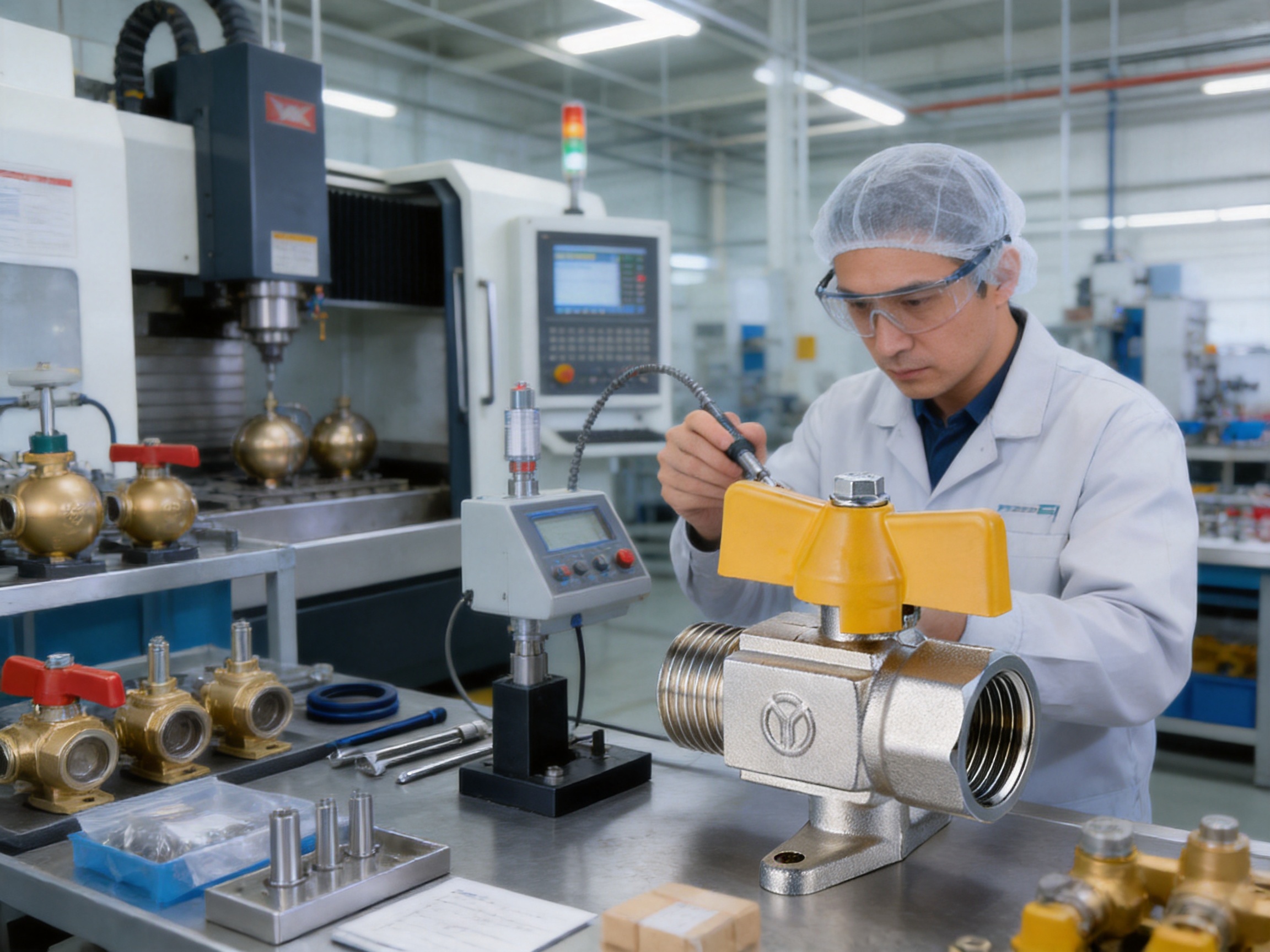
The company operates a professional, fully automated precision machining workshop. Precision machining is fundamental to the production of brass valve bodies. Thread dimensions, port alignment, internal passage geometry, sealing locations, and handle interfaces must be controlled closely to ensure that each component can be assembled and installed correctly.
Automated machining equipment can improve repeatability by maintaining programmed cutting sequences and reducing variation between production batches. It can also support efficient production of high-volume components while maintaining defined dimensional controls. For a valve with two different threaded ends, machining accuracy is particularly important because both connection directions must meet the required specifications.
Precision machining also influences the quality of internal surfaces. A suitable finish can help the ball rotate smoothly, support contact with sealing elements, and reduce the possibility of burrs or irregularities affecting flow. Machined parts should still be cleaned and inspected before assembly so that chips, dust, and residue do not enter the finished valve.
Automated Assembly Line
The company has established an assembly line supported by professional automated equipment. Consistent assembly is essential for ball valves because the final performance depends on the correct placement of the ball, seats, seals, stem, handle, and body components.
Automation can help control the sequence and repeatability of assembly operations. It may also reduce the risk of inconsistent manual force or omitted components. Standardized procedures provide a foundation for stable product quality, especially when the manufacturer produces large quantities for distributors, contractors, and original equipment customers.
For the YH-211, assembly quality is important not only to internal shutoff but also to the relationship between the valve body and the integrated base. The finished component must remain structurally stable while preserving proper movement of the operating handle and access to the threaded ports.
Testing Workshop
A professional testing workshop allows the manufacturer to evaluate valve performance before products leave the factory. Testing may include dimensional inspection, operating checks, sealing tests, pressure-related tests, appearance review, and packaging verification, depending on the product specification and applicable standards.
Testing is especially important for products used with gas and water because the cost of field leakage can be much higher than the cost of factory inspection. A systematic test process helps identify defective seals, machining problems, incomplete assembly, damaged threads, or operating irregularities before shipment.
Factory testing does not replace correct installation. It confirms the condition of the manufactured product under defined test conditions, while field performance also depends on pipe alignment, thread preparation, support, medium compatibility, temperature, pressure, and operating practices. The strongest quality system recognizes both factors.
Advanced CNC Equipment
The company is equipped with advanced domestic and international CNC machine tools. CNC technology supports repeatable production of valve components with controlled dimensions and consistent machining programs. It is particularly useful for threaded products, where small dimensional differences can affect engagement, sealing, and installation reliability.
Using advanced machine tools also supports production flexibility. The manufacturer can produce different models and configurations while maintaining organized process controls. This is beneficial for customers that require standard products as well as customized sizes, packaging, labeling, or connection arrangements.
Production Capacity
The company has an annual production capacity of approximately 2 million sets of valves and 10 million sets of hardware accessories. This capacity indicates that the manufacturer is equipped to support regular wholesale demand, distribution programs, project orders, and recurring supply schedules.
Large-scale capacity can provide several commercial benefits. It can improve product availability, support more predictable lead-time planning, and allow the manufacturer to maintain dedicated production resources for repeat orders. It may also help customers consolidate valve and hardware-accessory procurement through one specialized supplier.
Capacity must be supported by quality management. High output alone does not guarantee reliable products. The combination of machining capability, automated assembly, testing resources, professional management, and process discipline is what enables production scale to translate into dependable supply.
Manufacturing Process from Material to Finished Valve
Material Preparation
Production begins with the selection and preparation of brass material suitable for the intended valve body. Material control includes confirming the required grade, dimensions, surface condition, and traceability information. Consistent raw material supports stable machining and helps ensure that the finished body performs predictably.
Body Machining
The valve body is machined to create the external profile, internal cavity, threaded ports, stem opening, and mounting-base features. The F/M ends require separate attention because the male and female thread geometries are different. The machining process must preserve correct alignment across the valve so that the connected pipes can be installed without unnecessary bending or twisting.
After machining, components may undergo deburring and cleaning. Removing sharp edges and machining residues helps protect seals and improves the safety and appearance of the finished product. Threaded areas should be checked for damage or distortion before the parts proceed to assembly.
Component Inspection
Critical components such as the ball, stem, seats, rubber seals, handle, and fasteners should be inspected against defined requirements. Inspection can cover dimensions, surface condition, material characteristics, and fit with mating parts. Consistent component control reduces the risk that a small defect will affect the assembled valve.
Valve Assembly
During assembly, the sealing elements are positioned carefully, the ball is placed in the internal cavity, and the stem and handle are fitted in the correct orientation. The body is then closed and secured according to the manufacturing procedure. Assembly force and sequence must be controlled so that seals are not damaged and the ball rotates correctly.
The mounting base remains part of the body structure throughout the process. Its position and integrity should be checked to confirm that it can support the intended fixing method. The handle should operate smoothly without excessive looseness or interference.
Functional and Leak Testing
Finished valves are subjected to appropriate testing in the company’s testing workshop. The valve may be operated through open and closed positions, checked for smooth movement, and tested for leakage under specified conditions. The threaded ends and body joints require particular attention because leakage may occur at either the internal shutoff area or an external connection.
Products that pass inspection can then be prepared for packaging. Packaging should protect the threads, handle, base, and body surface from damage during storage and transportation. Clear identification helps customers match the product to purchase orders and installation requirements.
Installation Guidance
Confirming Compatibility
Before installation, confirm the valve size, thread standards, service medium, pressure range, temperature range, and applicable approvals. The F/M designation describes the connection arrangement, but it does not by itself confirm compatibility with every threaded system. Thread pitch, nominal diameter, sealing method, and regulatory requirements must all be checked.
Verify that the valve is suitable for gas, potable water, or another intended medium. If the system contains chemicals, high-temperature fluids, abrasive particles, or unusual gases, obtain technical confirmation before use. Material compatibility protects both the valve and the wider system.
Preparing the Pipeline
Inspect the pipe ends before connecting the valve. They should be clean, straight, correctly threaded, and free of burrs, rust flakes, cutting oil, or other contaminants. Damaged threads should be repaired or replaced rather than forced into the valve.
Check the alignment of the pipes. The valve should not be used to correct significant misalignment. Excessive force during installation can load the body and threaded connections, potentially affecting sealing performance. If necessary, adjust the pipe supports or use a suitable connector designed for alignment or movement.
Connecting the Threaded Ends
Apply an appropriate thread-sealing material in accordance with the service requirements and local regulations. Use only a sealant compatible with the working medium and the valve’s sealing materials. Avoid allowing excessive sealant to enter the internal passage, where it could interfere with the ball or seals.
Engage the threads by hand first to ensure that they are not cross-threaded. Tighten the connection with suitable tools while avoiding excessive torque. Do not use the handle, base, or another non-designed component as a lever for tightening the threaded ends.
Fixing the Integrated Base
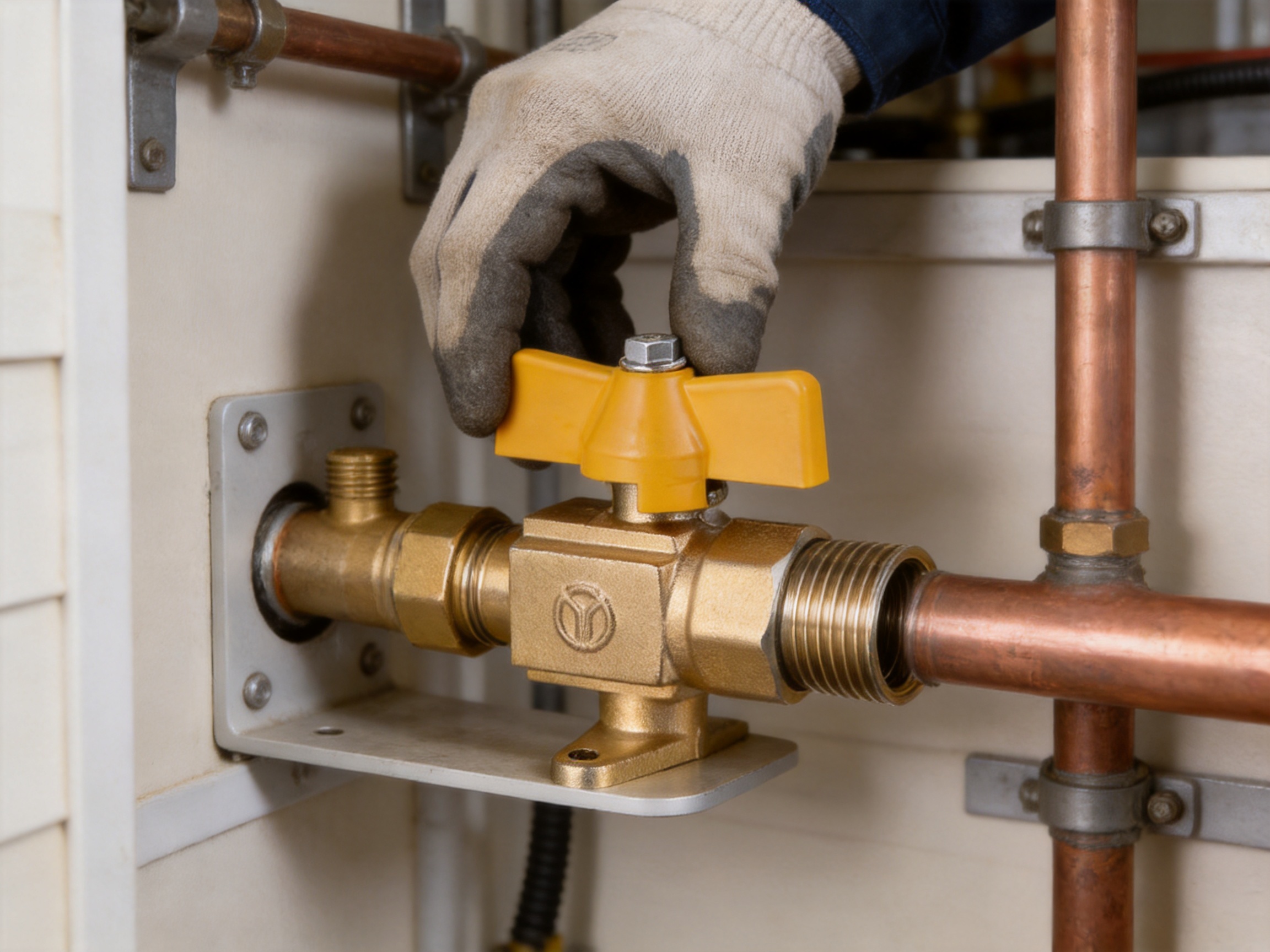
Position the valve so that the handle remains accessible and the base can be secured to a structurally sound surface. Select fasteners appropriate for the mounting material. The support should be strong enough to resist the operational forces and vibration expected in the installation.
Fixing the base should not distort the valve body. Tighten the mounting fasteners evenly and confirm that the valve still operates smoothly after it has been secured. The connected pipes should also have their own suitable supports where necessary; the integrated base is not a substitute for all pipeline support.
Testing after Installation
After installation, inspect all connections and confirm that the valve handle moves between the intended positions. Pressurize the system gradually and check for leakage using an approved method. Gas systems require specialized leak-testing procedures and must not be checked with an open flame.
If leakage is found, depressurize and make the system safe before attempting correction. Do not simply apply more force to a pressurized threaded connection. Recheck alignment, sealant, thread condition, and tightening procedure.
Operation and Maintenance
Operate the valve through a smooth quarter-turn movement. Avoid partially opening the valve for extended periods unless the application specifically permits throttling. Continuous throttling may increase turbulence, wear, and stress on the sealing components.
Keep the exterior clean and inspect the valve periodically. Look for corrosion, surface damage, loose fasteners, handle problems, evidence of leakage, or movement at the base. In vibrating environments, check the mounting hardware and adjacent pipe supports at regular intervals.
Do not force a valve that has become difficult to operate. Excessive force may damage the stem, handle, ball, or seals. First determine whether pressure imbalance, contamination, corrosion, or external pipe stress is causing the problem. If the valve cannot be restored safely, isolate the system and arrange for qualified maintenance.
For gas service, inspection frequency should follow local regulations and the requirements of the equipment owner. For water service, periodic inspection is still advisable, especially in concealed cabinets, utility rooms, and areas where a small leak could cause property damage.
Why the Product Offers Competitive Value
Function Integration
Many competing valves provide only the basic open-and-close function. The YH-211 adds a mixed connection arrangement and a dedicated mounting base. This integration can reduce the need to combine a standard valve with separate adapters and support hardware.
Fewer components can make the installation easier to understand and maintain. It may also reduce the space occupied by the finished connection. For contractors working on repeated layouts, a standardized integrated component can improve installation consistency across multiple sites.
Balanced Material and Performance
Brass provides a practical balance between strength, machinability, corrosion resistance, and cost. It is a familiar material for distributors, installers, and maintenance teams. The material is suitable for many ordinary water and gas applications when the service conditions and applicable requirements are correctly verified.
Support from Specialized Production
The product is backed by a manufacturer with dedicated valve and hardware-accessory capabilities. Precision machining, automated assembly, and testing resources support repeatable production rather than relying solely on informal manual processes. This is important for customers who need stable quality across recurring orders.
Adaptability to Different Projects
The valve can serve residential, commercial, equipment, and light industrial applications where its specifications are suitable. Its connection format is especially useful in projects involving branch connections, transition points, and replacement work. This broad adaptability can help distributors maintain a useful product for multiple customer groups.
Efficient Supply Capability
A reported annual capacity of 2 million valve sets and 10 million hardware-accessory sets indicates the ability to support substantial order volumes. Customers may benefit from a supplier that can provide both valve products and related hardware within a coordinated manufacturing structure.
Purchasing Considerations
Buyers should evaluate more than the appearance of the valve. Important questions include the required nominal size, thread standard, pressure class, medium, temperature, handle configuration, sealing material, mounting dimensions, packaging, and quality documentation.
For wholesale and distribution customers, consistency between batches is a major consideration. Confirm how product identification, carton quantities, labeling, inspection records, and replacement support are managed. A reliable supply program should include clear communication about specifications and any approved changes to materials or design.
For original equipment manufacturers, the integrated base and F/M connection may provide opportunities to simplify the equipment layout. However, the valve envelope, handle clearance, fixing-hole arrangement, and connection dimensions should be reviewed during the design stage. Prototype testing is recommended before large-scale integration into a new machine.
For contractors, installation efficiency and field compatibility are often the main priorities. Confirm thread standards before ordering and calculate whether the integrated base matches the planned support structure. It is also useful to keep appropriate sealing materials, tools, and testing equipment available at the installation site.
Safety and Service Limitations
This valve should be selected and installed only for service conditions within its intended design range. Do not assume that a brass ball valve is automatically suitable for every gas, liquid, pressure, or temperature. Chemical compatibility and regulatory compliance must be verified for each project.
Before maintenance, isolate the relevant pipeline and relieve pressure. Drain or purge the line when required. In gas systems, eliminate ignition sources and follow approved safety procedures. Only trained personnel should work on pressurized or hazardous-fluid systems.
The valve is generally intended for isolation rather than precision flow regulation. If the process requires stable modulation, proportional control, or automatic actuation, a purpose-designed control valve may be more appropriate. The YH-211’s strongest value is dependable manual shutoff combined with flexible connection and stable fixation.
Frequently Asked Questions
What does F/M mean in the product name?
F/M means female/male. One end of the valve has an internal female thread, and the opposite end has an external male thread. This allows the valve to connect different types of threaded pipe or fittings within one compact component.
What is the purpose of the integrated base?
The integrated base provides a dedicated point for fixing the valve to a wall, panel, equipment frame, or other suitable support. It helps reduce movement, vibration, and mechanical stress on the connected pipeline.
Is the valve intended for water or gas?
The valve is designed for compatible gas and tap-water applications, subject to confirmation of the exact specifications, approvals, pressure, temperature, and local regulations. Gas installation and testing should always be carried out by qualified personnel.
Can the valve be used for flow regulation?
It is primarily intended for on/off isolation. Although a ball valve can be partially opened, prolonged throttling may increase wear and turbulence. A dedicated regulating valve should be used when precise continuous flow control is required.
What are the main advantages over a standard two-female ball valve?
The YH-211 can connect directly to a mixed male/female threaded layout and may reduce the need for additional adapters. Its integrated base also provides a fixing option that a standard unsupported valve may not include.
Does the integrated base replace all pipe supports?
No. The base supports the valve itself, but the pipeline must still be supported according to its material, length, weight, vibration level, and installation requirements. Proper support prevents excessive loads from being transferred to the valve.
How should the valve be installed?
Confirm compatibility, clean and align the pipe ends, apply a suitable thread sealant, engage the threads by hand, tighten carefully with appropriate tools, secure the integrated base, and test the system for leakage after installation. Never force mismatched or cross-threaded connections.
What manufacturing capabilities support this product?
Ningbo Yunhua Valve Co., Ltd. operates a precision machining workshop, automated assembly line, and testing workshop. The company uses domestic and international CNC machine tools and professional automated assembly and testing equipment to support consistent production.
What is the manufacturer’s production capacity?
The company reports an annual production capacity of approximately 2 million sets of valves and 10 million sets of hardware accessories. This capacity supports wholesale, distribution, project, and recurring supply requirements.
How can leakage be prevented?
Use a valve that is compatible with the medium and operating conditions, prepare the threads correctly, apply suitable sealant, avoid cross-threading and over-tightening, support the valve and pipeline properly, and conduct a complete leak test after installation. Regular inspection is also recommended.
Can the valve be used in a confined equipment space?
Its compact ball-valve format and mixed-thread configuration can be useful in restricted spaces. However, adequate clearance must remain for handle movement, inspection, connection work, and future replacement.
What should be checked before bulk purchasing?
Buyers should confirm size, thread standard, service medium, pressure and temperature range, seal material, mounting dimensions, packaging, inspection documentation, order quantity, and delivery requirements. Samples or prototype testing may be appropriate for equipment integration.
Conclusion
The YH-211 Brass Ball Valve with Base (F/M) is designed to solve several common piping challenges in one component. Its quarter-turn ball mechanism provides quick manual isolation, while the brass body offers a practical combination of durability, machinability, and corrosion resistance for compatible applications. The female/male threaded configuration improves connection flexibility, and the integrated base supports stable fixation in wall-mounted, equipment-side, and vibration-sensitive installations.
Compared with a conventional valve that uses only a standard thread arrangement and has no dedicated mounting point, this design can reduce fitting complexity, shorten some connection layouts, and improve mechanical stability. Its value is particularly clear in branch connections, transition connections, compact service areas, and replacement projects where existing piping may not follow one uniform connection pattern.
The product is supported by Ningbo Yunhua Valve Co., Ltd.’s specialized manufacturing capabilities. The company’s precision machining workshop, automated assembly line, professional testing workshop, CNC equipment, management system, and substantial production capacity provide a foundation for consistent valve supply. These strengths make the product relevant to distributors, contractors, equipment manufacturers, and project customers seeking a practical brass valve with integrated installation support.
Correct selection and installation remain essential. Users should verify thread compatibility, service conditions, pressure and temperature limits, material suitability, and local safety requirements before placing the valve into operation. When properly selected, installed, supported, and maintained, the F/M brass ball valve with integrated base can provide a compact, reliable, and adaptable solution for many fluid-control systems.
References
1. Ningbo Yunhua Valve Co., Ltd. Product information for the YH-211 Brass Ball Valve with Base (F/M).
2. Ningbo Yunhua Valve Co., Ltd. Corporate information concerning valve production, machining, assembly, testing, and manufacturing capacity.
3. General engineering principles for manually operated quarter-turn ball valves and threaded piping connections.
4. General installation and maintenance practices for brass valves used in compatible water and gas service.
5. General industrial guidance concerning pipeline support, threaded joint preparation, leak testing, and fluid-system safety.
Product: YH-211 Brass Ball Valve with Base(F/M)

Related Products
Related News
Contact Us
-

-
 +86-0574-63742169
 -
 No.104-128, Cizhang East Road, Zhangqi Town, Cixi City, Ningbo, Zhejiang Province, China


Message Us Now !
