


 English
  русский
  عربى
عربى  Español
Irregular-Shaped Pipe Fittings: Precision Solutions for Complex Fluid Connections
Content
- 1 Understanding Irregular-Shaped Pipe Fittings
- 2 Why Complex Piping Systems Need Specialized Fittings
- 3 Key Design Advantages
- 4 Material and Application Considerations
- 5 Precision Manufacturing Process
- 6 Manufacturing Strengths Supporting Product Reliability
- 7 Advantages Compared with Conventional Alternatives
- 8 Applications in Gas and Fluid Systems
- 9 How to Select the Correct Fitting
- 10 Quality Control from Raw Material to Shipment
- 11 Customization and Project Support
- 12 Installation Recommendations
- 13 Lifecycle and Cost Benefits
- 14 Q&A
- 14.1 What is an irregular-shaped pipe fitting?
- 14.2 When should I choose an irregular-shaped fitting instead of standard fittings?
- 14.3 Can these fittings be used for gas systems?
- 14.4 What information is needed for a customized fitting?
- 14.5 How are irregular-shaped fittings manufactured?
- 14.6 Why is CNC machining important for these products?
- 14.7 How can I prevent leakage after installation?
- 14.8 Are fewer joints always better?
- 14.9 What manufacturing capabilities are important when purchasing these fittings?
- 14.10 Can irregular-shaped fittings improve equipment design?
- 15 Why Choose an Experienced Manufacturing Partner
- 16 Conclusion
- 17 References
- 18 Product: Irregular-Shaped Pipe Fittings
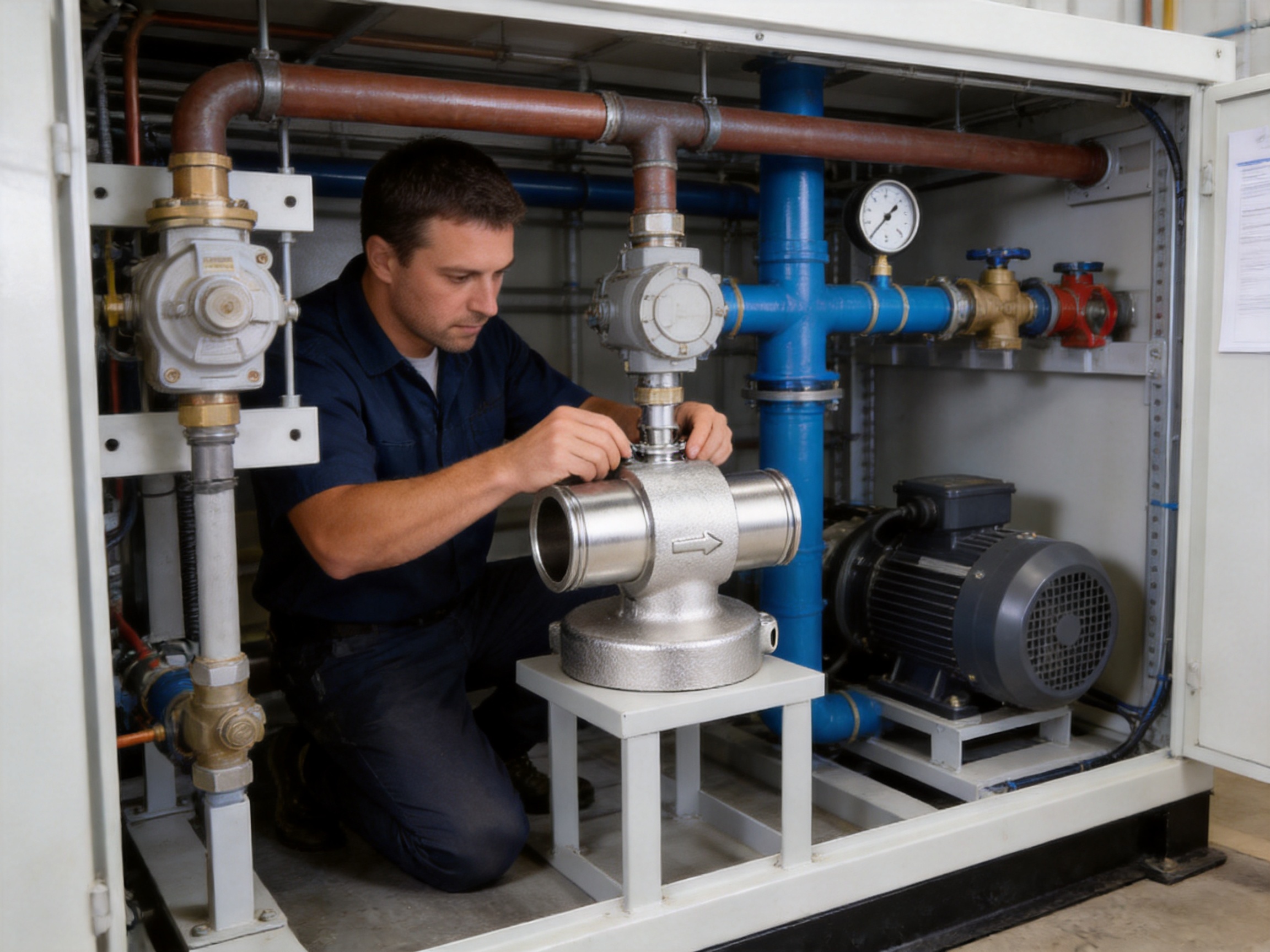
Irregular-shaped pipe fittings are essential components in fluid-control systems where standard elbows, tees, reducers, and couplings cannot provide the required connection geometry. Unlike conventional fittings with symmetrical or predictable profiles, irregular-shaped fittings are designed for unusual routing conditions, restricted installation spaces, offset connections, equipment interfaces, and specialized piping layouts. Their purpose is not simply to join two or more pipes, but to solve a particular engineering challenge while maintaining mechanical integrity, sealing reliability, and efficient fluid flow.
In modern industrial, commercial, agricultural, and residential systems, available installation space is often limited. Pipes may need to pass around structural members, connect to valves with non-standard orientations, compensate for offsets, or transition between different connection positions. An irregular-shaped pipe fitting can provide a practical and durable solution without forcing installers to use multiple standard fittings. This can reduce the number of joints, simplify assembly, lower the risk of leakage, and improve the overall appearance and serviceability of a finished system.
Ningbo Yunhua Valve Co., Ltd. develops and manufactures valves, fluid-control products, and hardware accessories for demanding applications. Its product portfolio includes irregular-shaped pipe fittings and related components used in gas, water, and fluid systems. Supported by a professional precision machining workshop, automated assembly lines, testing facilities, CNC equipment, and a substantial annual production capacity, the company is positioned to provide reliable fittings for both standard supply requirements and customized projects.
Understanding Irregular-Shaped Pipe Fittings
An irregular-shaped pipe fitting is a connection component whose body, outlet arrangement, angle, contour, or dimensional relationship differs from common symmetrical fitting designs. The term may describe a fitting with an offset centerline, a non-standard bend, an uneven body profile, a specialized outlet position, or a form developed for direct connection to equipment. The exact structure depends on the application and the required pipe layout.
Traditional pipe fittings are generally produced in familiar forms. A 90-degree elbow changes the direction of a pipeline, a tee divides or combines flow, a reducer changes the pipe diameter, and a coupling joins two pipe sections. These products are efficient when the installation follows a conventional pattern. However, a complex system may require a connection that cannot be achieved efficiently with these standard components alone.
For example, a pipe may need to move laterally while changing direction, connect to a valve that is positioned at an unusual angle, or join two pipes whose centerlines do not align. Using several standard elbows and short pipe sections may technically solve the problem, but it also creates more threaded or joined points. Each additional joint may increase installation time, pressure loss, inspection requirements, and potential leakage risk. An irregular-shaped fitting can combine several geometric functions into one engineered part.
These fittings may be used in gas supply systems, water distribution networks, fluid-control assemblies, equipment connection lines, hardware systems, and other installations requiring precise spatial adaptation. Their value is especially apparent where reliability and compact design are more important than the use of universally standardized shapes.
Why Complex Piping Systems Need Specialized Fittings
Pipeline design is influenced by more than the nominal pipe diameter. Engineers and installers must consider available space, connection direction, equipment position, support locations, maintenance access, thermal movement, pressure, vibration, and the properties of the transported medium. In a crowded mechanical room or compact equipment cabinet, a conventional fitting may extend too far, interfere with another component, or force the pipeline into an inefficient route.
Irregular-shaped fittings address these conditions by providing greater flexibility in the physical arrangement of a system. Instead of treating the fitting as a generic connector, manufacturers can develop the body around the actual installation requirement. This approach may involve an offset passage, an angled outlet, a stepped profile, a compact transition, or a combination of connection features.
Specialized geometry can also reduce the need for field modification. Cutting, bending, or adapting a standard fitting on site can introduce dimensional inaccuracies and surface damage. It may also compromise the sealing area or create an unsuitable flow path. A purpose-designed irregular fitting is manufactured under controlled conditions, allowing critical dimensions and connection surfaces to be inspected before shipment.
For original equipment manufacturers, a specialized fitting can help create a cleaner product design. It can connect a valve, pipe, regulator, manifold, or other component without adding unnecessary adapters. For distributors and contractors, it can provide a ready-to-install solution for projects in which standard parts are difficult to combine.
Key Design Advantages
Efficient Use of Installation Space
One of the principal advantages of irregular-shaped pipe fittings is their ability to work within confined or awkward spaces. Their profile can be adapted to avoid walls, frames, brackets, electrical components, insulation, and neighboring pipelines. A compact fitting may allow equipment to be installed closer to a wall or inside a cabinet while maintaining suitable access for operation and maintenance.
Space efficiency is important in residential gas systems, commercial utility rooms, industrial process equipment, water treatment systems, and packaged machinery. When several conventional fittings are assembled together, the resulting connection may become bulky. A single specialized fitting can often achieve a similar route with a shorter overall length and fewer external obstacles.
Fewer Connection Points
Every connection in a piping system is a point that must be assembled, sealed, inspected, and maintained. The use of multiple standard fittings may increase the number of threaded joints or sealing interfaces. An irregular-shaped fitting can combine several directional or dimensional requirements into one component, helping to minimize the number of joints.
Fewer joints may provide several practical benefits. Installation can be faster, the finished assembly can be more compact, and the number of locations requiring inspection can be reduced. In systems carrying gas or pressurized fluids, minimizing unnecessary connection points can also support improved leak-control performance when the fitting is correctly selected, installed, and tested.
Improved Routing Flexibility
Irregular-shaped fittings are suitable for layouts that involve offsets, non-standard angles, or unusual equipment interfaces. Their geometry can be developed to match the actual centerline relationship between two connection points. This is particularly useful when a pipe must move both horizontally and vertically within a limited distance.
Routing flexibility may reduce the need for forced alignment. Excessive force during installation can place stress on pipe threads, valve bodies, equipment ports, and support points. A properly designed fitting allows the system to be assembled in a more natural position, reducing the possibility of distortion caused by misalignment.
Reliable Sealing Performance
Sealing performance depends on accurate connection dimensions, appropriate materials, clean sealing surfaces, and correct installation procedures. Precision-machined irregular fittings can offer dependable connection interfaces when they are manufactured according to the required specifications. Consistent thread quality, controlled surface finish, and accurate geometry all contribute to a more reliable seal.
For gas and fluid applications, the fitting should be matched to the system pressure, temperature, medium, connection standard, and sealing method. Depending on the application, sealing may involve pipe threads, gaskets, O-rings, compression elements, or other approved methods. The fitting itself is one part of the complete sealing system, and performance depends on the compatibility of all connected components.
Better Assembly Appearance
Although appearance is not the primary performance criterion, a clean and organized installation is easier to inspect and maintain. A compact irregular-shaped fitting can eliminate unnecessary loops, adapters, and short pipe segments. This may produce a more orderly appearance, particularly in exposed plumbing, equipment skids, utility panels, and commercial installations.
An organized layout also makes it easier for technicians to identify valves, follow flow paths, and access service points. Good routing can support safer maintenance and reduce confusion during future repairs or equipment upgrades.
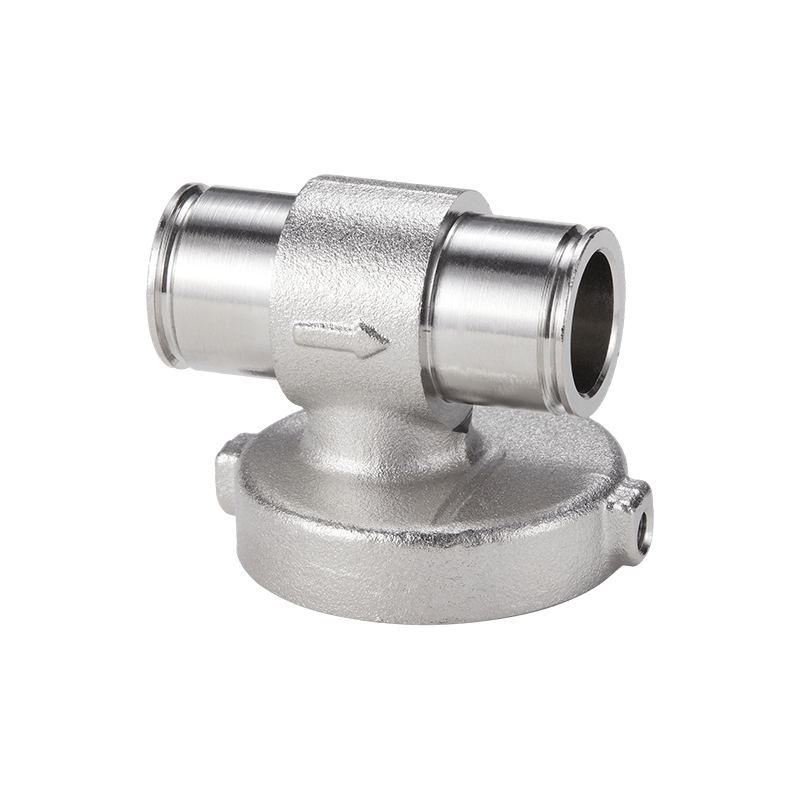
Irregular-Shaped Pipe Fittings
Material and Application Considerations
The correct material depends on the transported medium, operating pressure, temperature, environmental conditions, connection standard, and expected service life. Irregular-shaped fittings may be produced from metal alloys or other suitable engineering materials, depending on the required performance. In valve and hardware applications, material selection must also consider corrosion resistance, machinability, strength, sealing compatibility, and cost.
For water systems, the fitting should be suitable for the water quality and operating conditions. For gas systems, the materials and sealing arrangements must be appropriate for the gas medium and relevant safety requirements. For industrial fluids, engineers may need to evaluate chemical compatibility, erosion, temperature cycling, vibration, and possible contamination.
Brass and other copper-based alloys are commonly valued in many plumbing, gas, and hardware applications because they offer good machinability, practical corrosion resistance, and reliable performance in suitable environments. Steel and forged materials may be selected where higher mechanical strength, pressure resistance, or durability is required. The final choice should always be based on technical specifications and applicable standards rather than appearance alone.
Surface treatment may also be important. Depending on the application, a fitting may require cleaning, polishing, plating, coating, or another protective process. Surface condition affects not only corrosion resistance but also appearance, handling, and the quality of sealing interfaces. Critical connection areas should be protected from scratches, burrs, contamination, and deformation during production and packaging.
Precision Manufacturing Process
The performance of an irregular-shaped pipe fitting depends heavily on manufacturing accuracy. A complex external profile does not automatically guarantee a reliable product. The internal passage, connection dimensions, thread geometry, wall thickness, sealing surfaces, and alignment relationships must all be controlled during production.
Product Development and Drawing Review
Production begins with a clear understanding of the intended connection requirements. Technical information may include nominal size, inlet and outlet relationships, centerline offsets, connection type, material, pressure range, temperature range, sealing method, surface treatment, and packaging requirements. Drawings or approved samples provide the basis for manufacturing preparation.
Before machining begins, the design should be reviewed for manufacturability. Irregular geometry can create challenges related to tool access, workholding, internal passage formation, material thickness, and inspection. A thoughtful design review helps identify potential issues early and supports more stable production.
For customized orders, communication between the manufacturer and customer is especially important. Small differences in connection orientation or overall length can determine whether a fitting works correctly in the final assembly. Confirming the technical details before mass production helps reduce rework and improves delivery consistency.
Material Preparation
Material preparation establishes the foundation for the finished product. Raw material must be selected according to the approved specification and formed into a suitable blank for machining or forging. The blank should provide enough material for the final geometry while supporting efficient production and stable dimensional control.
Material identification and handling procedures are important for preventing mix-ups. Different alloys may have similar appearances but significantly different mechanical or corrosion properties. Organized storage, traceable batches, and suitable inspection practices support consistent product quality.
Forging or Forming
Where appropriate, forging or forming can be used to create a strong and efficient base shape. A formed body may provide a favorable grain structure and reduce the amount of material that must be removed during machining. This can be valuable for fittings exposed to mechanical loads, pressure, vibration, or repeated installation forces.
Forming processes must be carefully controlled to avoid defects such as cracks, incomplete filling, excessive deformation, or undesirable wall-thickness variation. The selected process depends on the material, product geometry, production volume, and performance requirements.
CNC Precision Machining
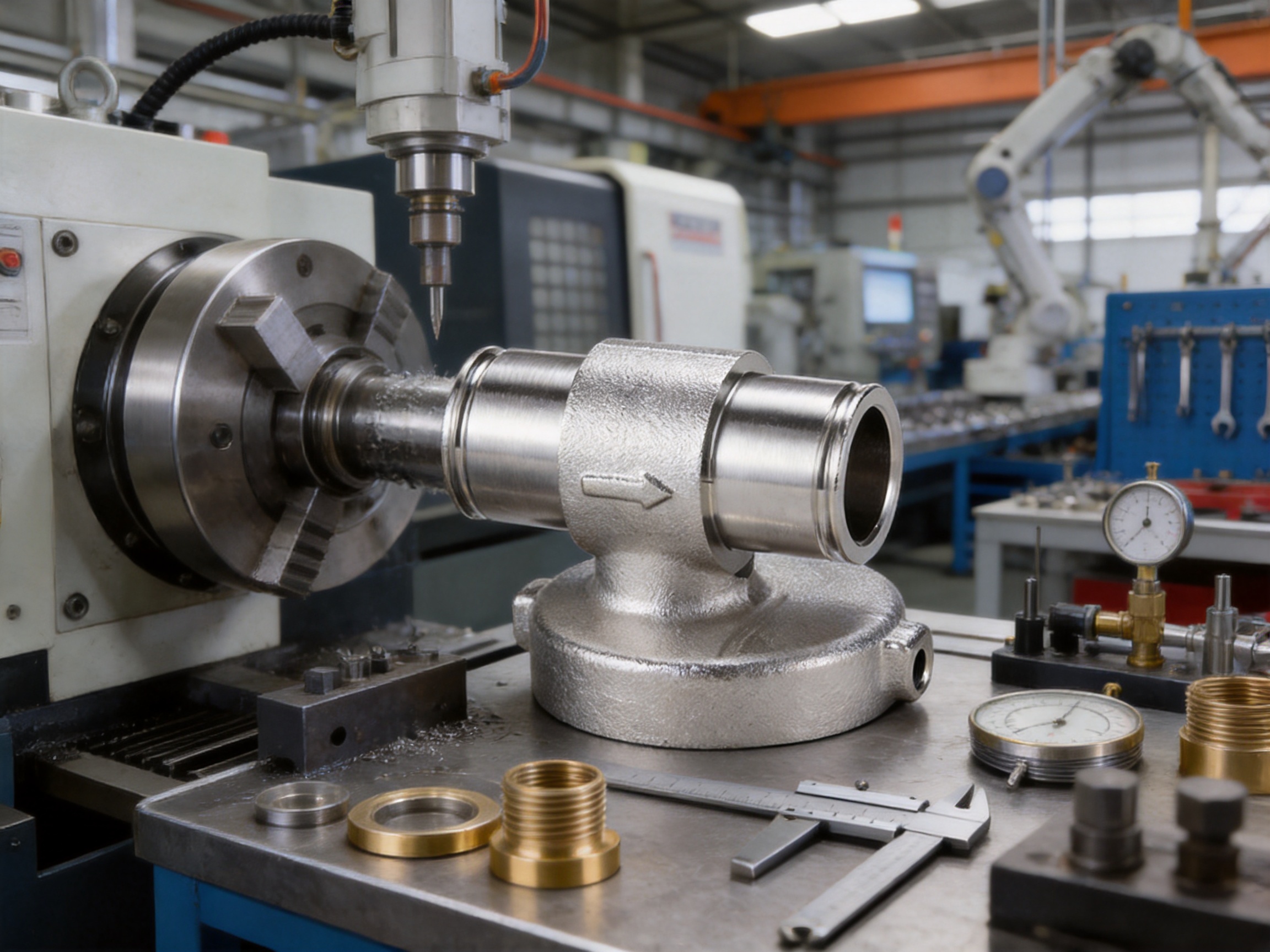
Computer numerical control machining is a central process for producing accurate irregular-shaped fittings. CNC equipment can control turning, drilling, milling, threading, facing, boring, and other operations with repeatable precision. This is particularly important when a fitting has multiple connection surfaces or an unusual relationship between its outlets.
Machining operations must be arranged in a logical sequence. Reference surfaces are established, critical dimensions are produced, and internal passages are formed without damaging previously finished areas. Proper tooling, cutting parameters, workholding, coolant management, and tool-condition monitoring all contribute to product consistency.
Advanced CNC machine tools can reduce variation between production batches. They also support efficient production of repeat orders and provide the flexibility required for different fitting configurations. For a manufacturer serving multiple markets, this combination of precision and flexibility is a significant advantage.
Thread and Connection Processing
Threads are among the most important functional features of many pipe fittings. They must be formed according to the specified standard, nominal size, pitch, taper, and orientation. Thread quality affects assembly force, sealing performance, interchangeability, and service reliability.
During processing, attention must be given to thread profile, lead, depth, surface finish, and protection against burrs. The mating component must also be compatible. A fitting with accurate threads may still fail to seal if it is assembled with an incompatible thread standard or an unsuitable sealant.
Other connection types may require accurate bores, grooves, shoulders, compression surfaces, or gasket seats. These features should be machined and inspected according to their functional importance.
Deburring and Surface Finishing
After machining, sharp edges and burrs must be removed. Internal burrs can interfere with flow, damage seals, or become detached and enter downstream equipment. External burrs can create handling hazards or prevent proper assembly.
Surface finishing may include cleaning, polishing, coating, plating, or other treatments. The selected process should be compatible with the base material and intended application. Finished surfaces should be protected during handling so that sealing areas and visible surfaces remain free from damage.
Cleaning and Assembly
Cleanliness is important in water, gas, and fluid-control systems. Machining chips, oil residue, dust, and abrasive particles should be removed before the fitting is packed or assembled. The level of cleaning required depends on the application and customer specification.
When a fitting is supplied as part of an assembly, automated or controlled manual assembly can help provide consistent installation of seals, inserts, nuts, or related components. Assembly equipment should be adjusted to avoid over-tightening, seal damage, cross-threading, or incorrect orientation.
Testing and Final Inspection
Testing verifies whether the finished product meets its intended functional requirements. Depending on the product design, testing may include dimensional inspection, thread gauging, visual inspection, pressure testing, leak testing, and functional checks. Test methods should be selected according to the fitting type and application.
Dimensional inspection confirms that the fitting can be installed correctly. Thread gauges help verify that connection features are within the required limits. Pressure and leak tests provide additional evidence of sealing integrity. Visual inspection can identify surface defects, contamination, deformation, or damage that may not be detected by a single dimensional measurement.
A reliable quality system does not rely only on final inspection. Quality should be supported throughout the process, beginning with material preparation and continuing through machining, cleaning, assembly, testing, and packaging. Process control helps prevent defects instead of merely identifying them after production is complete.
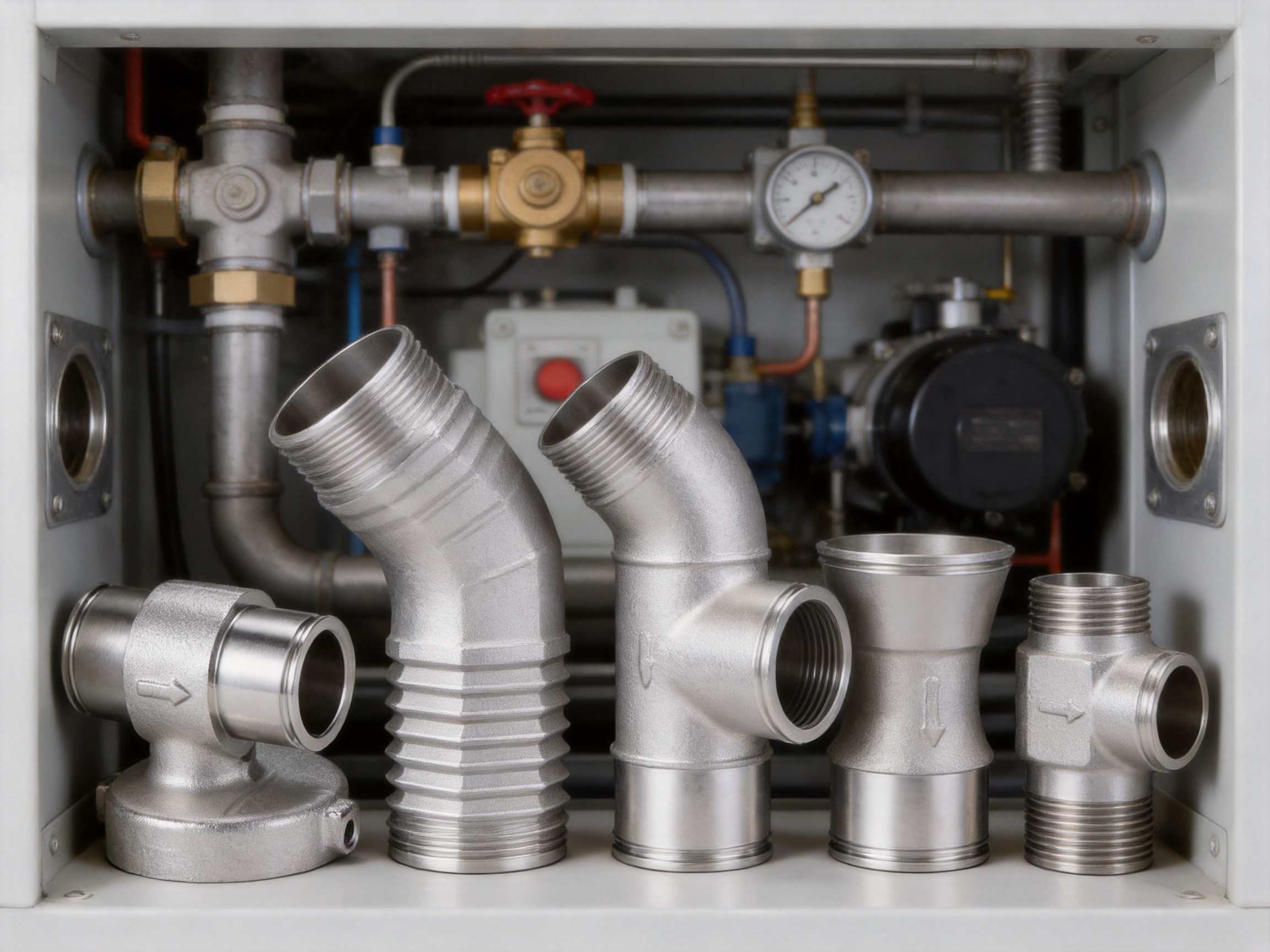
Manufacturing Strengths Supporting Product Reliability
Ningbo Yunhua Valve Co., Ltd. has developed an integrated production structure for valves and hardware accessories. The company covers approximately 20,000 square meters and operates a professional precision machining workshop, assembly line, and testing workshop. This production environment supports coordinated control of machining, assembly, and verification.
The company is equipped with domestic and international CNC machine tools as well as automated assembly and testing equipment. This equipment helps support repeatable production, accurate processing, and efficient handling of different product configurations. For irregular-shaped fittings, the ability to combine flexible machining with controlled inspection is particularly valuable because these products may contain multiple critical dimensions that must work together.
Automation can improve consistency in repetitive operations while reducing variation caused by manual handling. It can also help increase production efficiency and support stable delivery for larger orders. However, automation is most effective when combined with clear process standards, skilled technical management, preventive maintenance, and appropriate inspection procedures.
The company has an annual production capacity of approximately 2 million sets of valves and 10 million sets of hardware accessories. This capacity indicates that the manufacturer is prepared to support both regular supply programs and larger-volume procurement requirements. Production scale can also contribute to more efficient material planning, process optimization, equipment utilization, and quality-system development.
At the same time, irregular-shaped fittings often require closer attention than simple mass-produced components. A capable manufacturer must balance production efficiency with the need to manage drawings, tooling, setup parameters, inspection points, and customer-specific requirements. An established production system provides the infrastructure for this balance.
Advantages Compared with Conventional Alternatives
| Evaluation Factor | Irregular-Shaped Pipe Fittings | Multiple Standard Fittings | Field-Modified Components |
|---|---|---|---|
| Installation space | Designed for a specific compact or offset layout | May require additional length and clearance | Depends on the quality of field modification |
| Number of joints | Can combine several routing functions in one component | Usually requires more connections | May vary according to the modification method |
| Dimensional consistency | Produced under controlled manufacturing conditions | Generally consistent, but alignment depends on assembly | Can vary between installations |
| Leakage risk management | Fewer joints may simplify inspection and sealing | More joints create more inspection points | May be affected by cutting, bending, or rework |
| Installation speed | Can reduce fitting selection and assembly time | Requires several components to be measured and connected | May require additional tools and site labor |
| Appearance | Often produces a cleaner, more integrated layout | Can result in a bulky or complicated arrangement | Depends on workmanship and available space |
| Customization potential | Can be developed around defined technical requirements | Limited to available standard configurations | Limited by field equipment and material conditions |
The comparison does not mean that irregular-shaped fittings replace every standard fitting. Standard components remain highly useful for common, predictable layouts and are often the most economical choice for straightforward installations. The advantage of an irregular-shaped fitting appears when the system has a spatial, dimensional, or connection challenge that standard parts cannot solve efficiently.
Compared with using several standard fittings, a specialized component may reduce assembly complexity and overall footprint. Compared with field modification, a factory-produced fitting can provide better control over dimensions, surface quality, and inspection. The final decision should consider the complete system, including material, pressure, temperature, standards, service conditions, quantity, and lifecycle cost.
Applications in Gas and Fluid Systems
Gas Supply Assemblies
Gas systems require careful attention to sealing, material compatibility, mechanical stability, and installation quality. Irregular-shaped fittings can be used where gas piping must connect to valves, regulators, appliances, or equipment in a compact arrangement. Their ability to reduce unnecessary joints may help simplify the installation, provided that the fitting is approved for the specific gas service and installed according to applicable requirements.
Gas applications demand disciplined inspection and testing. Installers should verify the connection standard, use an appropriate sealing method, avoid contamination, and complete leak checks before commissioning. A specialized shape improves routing, but it does not remove the need for correct system design and safe installation practices.
Water Supply Systems
Water supply networks often contain crowded valve boxes, pump assemblies, treatment equipment, and distribution manifolds. An irregular-shaped fitting can help connect components where conventional elbows or tees would interfere with supports or adjacent lines.
In building services, compact fittings may be useful around water meters, shut-off valves, heaters, filtration units, and equipment connection points. In industrial water systems, they can help organize pipe routes and facilitate access to service components.
Valve and Regulator Connections
Valves and regulators frequently require carefully positioned inlet and outlet connections. A specialized fitting can assist with the transition between the valve body and a fixed pipeline, especially when the component orientation cannot be changed.
Because valves may be operated, inspected, or replaced during maintenance, the fitting arrangement should preserve access to handles, actuators, fasteners, and identification marks. A compact design is beneficial only when it does not create a maintenance obstruction.
Equipment and Machinery
Equipment manufacturers often design products around a fixed enclosure, frame, or base. Pipe connection points may be positioned to suit the equipment rather than a standard pipeline grid. Irregular-shaped fittings can bridge unusual connection locations while keeping the overall package compact.
They may be used in pumps, heating equipment, control panels, fluid-processing machinery, agricultural systems, and packaged utility units. For original equipment production, a defined fitting geometry can be repeated across many units, supporting consistent assembly and a standardized bill of materials.
Hardware Accessory Systems
Hardware accessories often include small but important connection components used in plumbing, construction, equipment assembly, and maintenance. An irregular-shaped fitting can provide a practical solution when the available installation arrangement is not compatible with common hardware.
Because these components may be installed by different users and in different environments, clear dimensions, accurate descriptions, reliable packaging, and consistent production are important. The fitting should be easy to identify and should arrive with its functional surfaces protected.
How to Select the Correct Fitting
Confirm the Connection Standards
The first step is to identify the connection types on both sides of the fitting. These may include different thread standards, nominal sizes, genders, or connection technologies. A fitting should not be selected based only on approximate diameter. Thread profile, pitch, taper, and sealing method must also be confirmed.
Measure the Centerline Relationship
For an irregular-shaped fitting, the relationship between connection points is critical. Measurements may include center-to-center distance, offset, outlet angle, overall length, orientation, and available clearance. A drawing or three-dimensional model is useful for avoiding misunderstandings.
Evaluate Operating Conditions
Important operating conditions include working pressure, maximum and minimum temperature, fluid type, flow rate, vibration, installation environment, and expected service life. The selected material and design must be suitable for these conditions.
Consider Installation and Maintenance
The fitting should be easy to install without excessive force or awkward tooling. There should also be enough space for tightening, inspection, leak testing, and future replacement. If the fitting is installed near a valve or regulator, the layout should allow access to operating components.
Review Quantity and Customization Requirements
For a one-time repair, an existing fitting configuration may be the most practical solution. For a recurring project or equipment program, customized production may provide better long-term efficiency. Customers should provide accurate drawings, samples, specifications, and expected quantities so the manufacturer can recommend a suitable production method.
Quality Control from Raw Material to Shipment
A dependable fitting requires more than a good design. The entire manufacturing chain must be controlled. Incoming materials should be checked against the approved specification. Production equipment should be maintained and calibrated as required. Operators should follow documented procedures, and critical dimensions should be monitored during machining.
Inspection frequency may depend on product risk, production volume, process stability, and customer requirements. First-piece inspection is valuable when a new setup, tool, material batch, or customized design is introduced. In-process checks help detect drift before a large quantity is completed. Final inspection confirms that finished goods are suitable for shipment.
Packaging is another important part of quality assurance. Threads, sealing surfaces, and finished exterior areas can be damaged by impact, moisture, dust, or contact with other metal parts. Appropriate protective materials and organized packing help ensure that products arrive in usable condition.
Traceable production records can support technical communication and after-sales service. When a question arises about dimensions, materials, testing, or delivery, clear records make it easier to identify the relevant batch and review the production process.
Customization and Project Support
Irregular-shaped fittings are often selected because a standard catalog item cannot meet the actual requirement. Customization may involve changes to the body profile, outlet location, angle, length, thread type, material, surface treatment, marking, or packaging.
A successful customized project begins with complete technical information. Useful materials include a dimensioned drawing, a sample part, a photograph with measurements, a three-dimensional model, or a description of the connected equipment. The customer should also identify the working medium, pressure, temperature, required quantity, applicable standards, and expected delivery schedule.
Manufacturers can then evaluate the design, determine suitable machining or forming methods, identify inspection points, and estimate tooling or setup requirements. For repeat orders, the approved design can be incorporated into a controlled production process to support consistent future supply.
Customization should not be limited to shape alone. A fitting that looks correct may still be unsuitable if its internal passage, wall thickness, material, or sealing interface does not meet the system requirement. A technically responsible development process considers both external fit and functional performance.
Installation Recommendations
Before installation, inspect the fitting for visible damage, contamination, deformation, or incorrect dimensions. Confirm that the product matches the intended connection standard and that all mating components are compatible.
Clean the connection surfaces and remove foreign material from the pipe and fitting. Use only an approved sealing method for the application. Excessive sealant should be avoided because it can enter the flow passage or interfere with valves and regulators.
Align the fitting and pipe naturally. Do not use the fitting to force misaligned pipes into position. Excessive external loading may damage threads or connected equipment. Tighten according to the applicable installation procedure and avoid over-tightening.
After assembly, inspect the connection and perform the required pressure or leak test before placing the system into service. Gas systems require particular attention to safety procedures and should be tested using approved methods by qualified personnel.
During operation, monitor for leakage, unusual vibration, corrosion, or movement. If the fitting is located in a high-temperature, chemically aggressive, or mechanically active environment, periodic inspection should be included in the maintenance program.
Lifecycle and Cost Benefits
The initial purchase price is only one part of the economic value of a pipe fitting. A fitting that reduces labor, installation time, rework, and maintenance complexity may provide a lower total cost over its service life.
Fewer connections can reduce the amount of sealant, labor, and inspection required. A compact configuration may reduce support materials and make better use of valuable installation space. Factory-controlled production can also reduce the likelihood of inconsistent field modifications.
For equipment manufacturers, a repeatable irregular fitting may simplify assembly instructions and reduce the number of separate components in the bill of materials. For contractors, it can shorten installation work when the fitting is correctly matched to the project. For distributors, a stable supply of specialized hardware can help address customer requests that cannot be fulfilled with basic standard fittings.
Lifecycle value also depends on product reliability. A fitting that maintains its sealing and mechanical performance can help reduce unplanned downtime, service calls, and replacement work. This is why material selection, precision machining, testing, and proper installation should be evaluated together.
Q&A
What is an irregular-shaped pipe fitting?
It is a pipe connection component with a non-standard body profile, outlet position, angle, offset, or dimensional relationship. It is designed to solve a specific routing or equipment-connection challenge that may not be handled efficiently by conventional elbows, tees, reducers, or couplings.
When should I choose an irregular-shaped fitting instead of standard fittings?
Choose one when the installation has limited space, unusual centerline positions, offset connections, equipment interfaces, or a need to reduce the number of joints. Standard fittings remain suitable for simple and conventional layouts, while irregular-shaped fittings are more valuable for complex arrangements.
Can these fittings be used for gas systems?
They may be used for gas systems when the specific product, material, connection type, sealing method, and testing requirements are suitable for the intended gas service. The system must be designed and installed according to applicable safety regulations and professional procedures.
What information is needed for a customized fitting?
Useful information includes a dimensioned drawing or sample, pipe sizes, connection standards, centerline offsets, outlet angles, overall dimensions, material requirements, operating pressure, temperature, fluid type, surface treatment, quantity, and packaging requirements.
How are irregular-shaped fittings manufactured?
Typical processes may include material preparation, forging or forming, CNC turning and milling, drilling, boring, thread processing, deburring, surface finishing, cleaning, assembly, dimensional inspection, pressure testing, leak testing, and final packaging. The exact process depends on the design and material.
Why is CNC machining important for these products?
Irregular-shaped fittings may contain several related dimensions and connection features. CNC machining helps control these features with repeatable accuracy and supports stable production for both standard configurations and customized designs.
How can I prevent leakage after installation?
Use compatible components, confirm the connection standard, keep sealing surfaces clean, apply an approved sealing method, avoid cross-threading, prevent pipe misalignment, and tighten according to the correct procedure. A pressure or leak test should be completed before operation.
Are fewer joints always better?
Fewer joints can simplify assembly and reduce the number of potential leak points, but the fitting must still be suitable for the pressure, temperature, medium, and installation conditions. A specialized fitting should not be used merely to reduce joint count if it creates a maintenance or flow problem.
What manufacturing capabilities are important when purchasing these fittings?
Important capabilities include precision CNC machining, reliable material control, controlled thread processing, automated or standardized assembly, testing equipment, dimensional inspection, surface finishing, stable production capacity, and the ability to manage customized drawings or samples.
Can irregular-shaped fittings improve equipment design?
Yes. They can help equipment manufacturers connect fixed ports within a compact enclosure, reduce adapters, simplify assembly, and create a more organized product layout. The design should be validated for access, serviceability, flow, and mechanical loading.
Why Choose an Experienced Manufacturing Partner
Specialized fittings require coordination between design interpretation, material selection, machining, inspection, assembly, and logistics. An experienced manufacturer can help identify practical solutions before production begins and can maintain consistency when the same product is ordered repeatedly.
Ningbo Yunhua Valve Co., Ltd. combines product development, precision machining, automated assembly, testing, and service within an established manufacturing organization. Its experience in valves, gas and fluid products, water supply valves, and hardware accessories provides a practical foundation for producing connection components used in fluid-control systems.
The company’s professional workshops and equipment support the production of components that require accurate dimensions and dependable assembly. Its production capacity supports volume orders, while its technical structure can also accommodate product requirements that differ from basic standard fittings. This combination of manufacturing scale and product specialization is an advantage for customers seeking a stable supply partner.
The company’s stated vision is to become a leading enterprise in the global fluid-control industry, while its mission emphasizes the development of a safe fluid ecosystem through high-quality valves. These objectives are relevant to irregular-shaped pipe fittings because connection accessories contribute directly to the reliability of complete gas and fluid systems.
Conclusion
Irregular-shaped pipe fittings provide an effective answer to complex connection problems that cannot be solved efficiently with standard components. Their advantages include compact installation, flexible routing, fewer joints, improved alignment, cleaner appearance, and the potential for lower installation and lifecycle costs.
The quality of these benefits depends on precise design and controlled manufacturing. Accurate drawings, appropriate materials, CNC machining, reliable thread processing, careful deburring, effective cleaning, automated assembly, dimensional inspection, and pressure or leak testing all contribute to dependable performance.
With a 20,000-square-meter production area, precision machining facilities, automated assembly and testing equipment, CNC capabilities, and substantial annual production capacity, Ningbo Yunhua Valve Co., Ltd. is equipped to support the manufacture and supply of irregular-shaped pipe fittings and related hardware accessories. Its experience across gas, water, valve, and fluid-control applications enables customers to seek solutions that are not only physically compatible but also suitable for practical system requirements.
When selecting an irregular-shaped fitting, buyers should evaluate the complete application rather than focusing only on external shape or price. Connection standards, material, pressure, temperature, fluid compatibility, installation space, maintenance access, quality control, and supplier capability should all be considered. A well-designed and well-manufactured fitting can become a small but important part of a safer, more efficient, and more reliable fluid-control system.
References
International Organization for Standardization. Principles of dimensional control and quality management for manufactured mechanical components.
American Society of Mechanical Engineers. General guidance concerning pressure piping design, component selection, and inspection.
International Organization for Standardization. Technical principles for metallic pipe threads and threaded connection verification.
American Society for Testing and Materials. Standard practices for material evaluation, dimensional inspection, and pressure-related product testing.
Manufacturing engineering references on computer numerical control machining, thread production, deburring, surface finishing, and process capability.
Technical guidance for gas, water, and industrial fluid piping installation, leak testing, maintenance, and safe system operation.
Product: Irregular-Shaped Pipe Fittings

Related Products
Related News
Contact Us
-

-
 +86-0574-63742169
 -
 No.104-128, Cizhang East Road, Zhangqi Town, Cixi City, Ningbo, Zhejiang Province, China


Message Us Now !
