


 English
  русский
  عربى
عربى  Español
Brass Threaded Gate Valve for Reliable Water and Fluid Shut-Off
Content
- 1 Understanding the YH-103 Brass Threaded Gate Valve
- 2 Core Performance Characteristics
- 3 Dimensional Range and Product Selection
- 4 Advantages of the Brass Construction
- 5 Gate Valve Design Benefits
- 6 Comparison with Alternative Valve Types
- 7 Manufacturing Strengths and Quality Approach
- 8 Installation Guidance
- 9 Maintenance and Service Practices
- 10 Application Areas
- 11 Why Manufacturer Support Matters
- 12 Procurement Considerations
- 13 Responsible Use and System Design
- 14 Frequently Asked Questions
- 14.1 What type of valve is the YH-103?
- 14.2 What media can the valve handle?
- 14.3 What is the pressure rating?
- 14.4 What is the operating temperature range?
- 14.5 What connection standard does it use?
- 14.6 Which sizes are available?
- 14.7 Is the stem rising or non-rising?
- 14.8 Can the valve be used to regulate flow continuously?
- 14.9 Is the valve suitable for potable water?
- 14.10 What are the main advantages over a basic alternative valve?
- 14.11 How should the valve be installed?
- 14.12 What maintenance does the valve require?
- 14.13 Who manufactures the product?
- 15 Conclusion
- 16 References
- 17 Product: YH-103 Brass Threaded Gate Valve
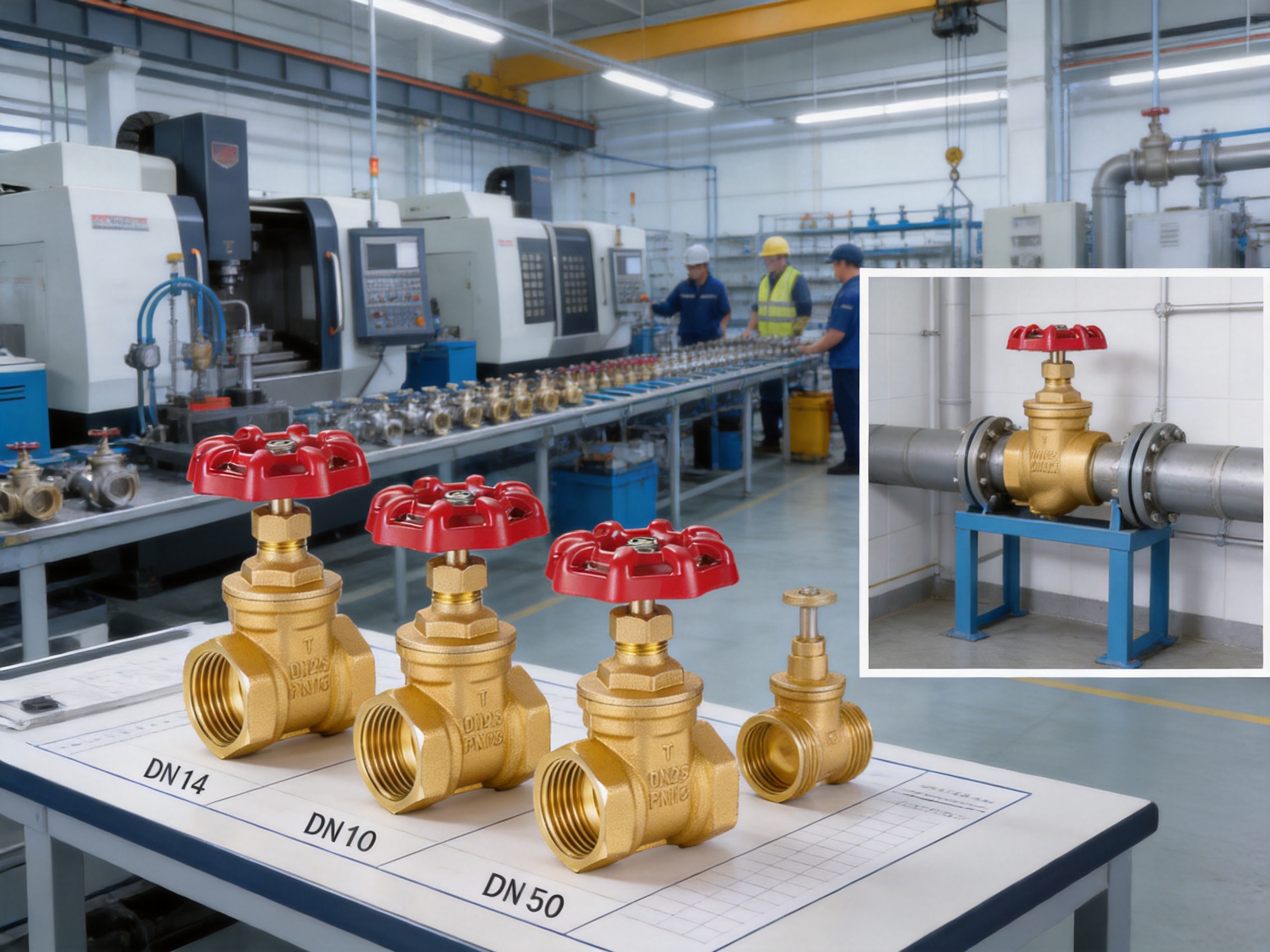
In residential plumbing, commercial water distribution, and selected industrial service lines, a dependable shut-off valve is essential. The valve must isolate a section of pipe, remain secure under operating pressure, resist corrosion, and continue functioning after repeated use. The YH-103 brass threaded gate valve is designed for these requirements. It combines a durable brass body, a solid wedge closing mechanism, a compact non-rising stem, and parallel pipe threads manufactured to ISO 228 requirements.
As a brass gate valve, the YH-103 is intended primarily for on-off service rather than continuous flow throttling. When fully open, its internal passage is designed to create minimal resistance to flow. When fully closed, the wedge moves into position to provide a tight shut-off. This operating principle makes the valve suitable for water supply networks, building plumbing, equipment connections, and compatible non-caustic liquid applications.
The product is available in nominal sizes from DN15 through DN50, corresponding approximately to 1/2 inch through 2 inches. It has a nominal pressure rating of 1.6 MPa and is specified for water and non-caustic liquids at temperatures from 0°C to 120°C. Its threaded construction supports practical installation where compact, serviceable, and removable pipe connections are preferred.
Understanding the YH-103 Brass Threaded Gate Valve
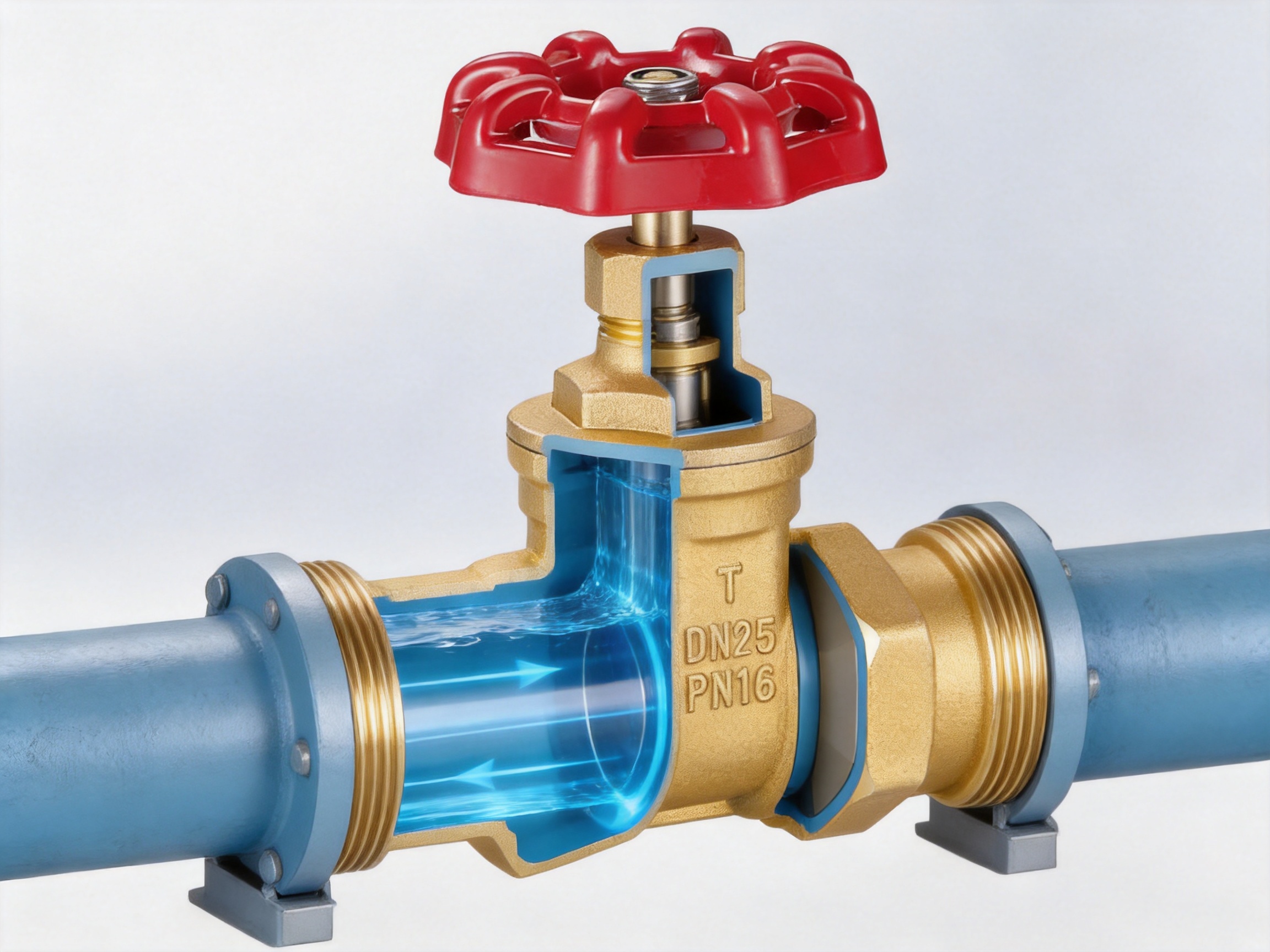
A gate valve controls fluid by moving a gate, commonly described as a wedge, into or out of the flow path. Turning the handwheel or operating component moves the stem, which raises or lowers the gate. In the open position, the gate is withdrawn from the passage, allowing fluid to pass through with relatively little obstruction. In the closed position, the gate blocks the passage and separates the upstream and downstream sides.
The YH-103 uses a brass construction selected for strength, serviceability, and resistance to ordinary atmospheric and water-related corrosion. Brass is widely used in plumbing valves because it provides a useful balance of mechanical durability, machinability, dimensional stability, and long-term performance. It can also be accurately machined to produce clean threaded connections and reliable internal mating surfaces.
The non-rising stem is an important feature for installations where vertical clearance is limited. On a conventional rising-stem valve, the stem moves upward as the valve opens, increasing the space required above the valve. A non-rising stem remains within the valve envelope while the gate moves internally. This allows the YH-103 to be installed in compact service cabinets, utility areas, plant rooms, equipment assemblies, and other locations where overhead space is restricted.
Although gate valves are often associated with large industrial pipelines, a compact threaded brass gate valve is valuable in smaller systems. It can isolate branches, supply lines, tanks, water heaters, pumps, filtration equipment, and maintenance zones. The threaded format also makes it possible to connect the valve directly to compatible threaded fittings without requiring welding or flanged assembly.
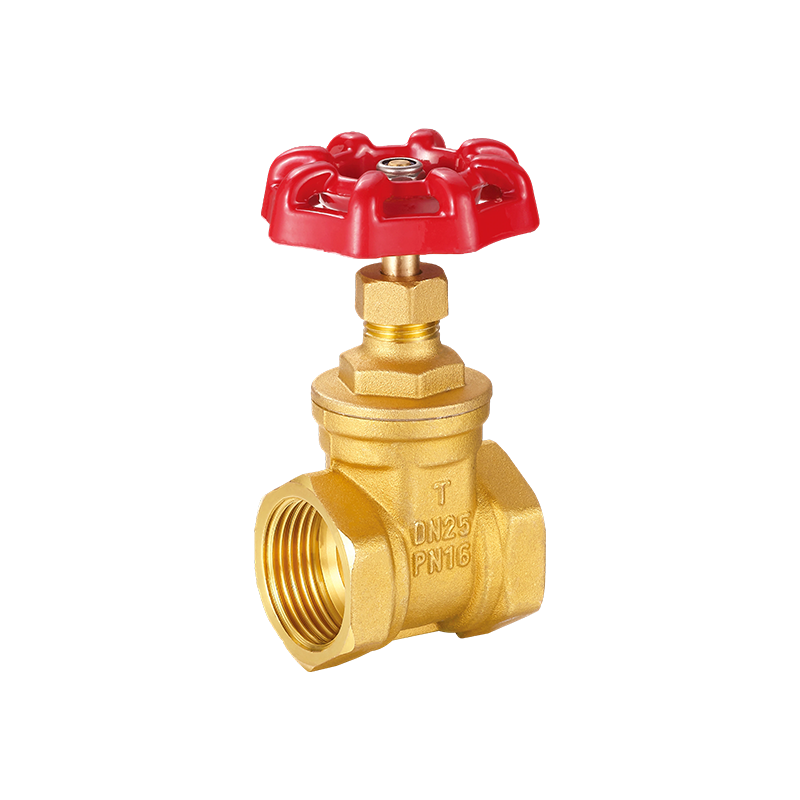
YH-103 Brass Threaded Gate Valve
Core Performance Characteristics
1. Nominal Pressure Rating of 1.6 MPa
The YH-103 is rated at a nominal pressure of 1.6 MPa. This rating provides a clear reference for engineers, installers, and purchasing teams when selecting the valve for a compatible system. The actual suitability of a valve depends on the complete operating conditions, including fluid type, temperature, pressure fluctuations, installation quality, and local regulations.
A pressure rating should not be interpreted as permission to exceed the manufacturer’s specified operating range. The valve should be selected with an appropriate safety margin, and the complete piping system should be reviewed as a whole. Pressure surges, water hammer, pump start-up conditions, and thermal expansion can affect service performance even when the normal working pressure appears acceptable.
2. Water and Non-Caustic Liquid Service
The specified working media are water and non-caustic liquids. This makes the valve suitable for many ordinary water supply and fluid distribution applications. Typical examples may include potable water lines, general utility water, building services, irrigation systems, compatible process water, and selected industrial liquid lines.
Fluid compatibility must always be verified before installation. “Non-caustic liquid” is a broad operating description, not a universal chemical compatibility guarantee. The liquid’s concentration, temperature, additives, cleanliness, and exposure duration may influence the service life of brass components and sealing materials. For chemical applications, the system designer should confirm compatibility with the valve manufacturer and applicable technical documentation.
3. Operating Temperature from 0°C to 120°C
The stated working temperature range is 0°C to 120°C. This range supports cold-water systems, general hot-water applications, and selected elevated-temperature fluid services. The upper limit should be treated as a design boundary rather than a target operating condition. Pressure, material performance, and seal durability may change as temperature rises.
Where a system cycles repeatedly between cold and hot conditions, thermal expansion and contraction may place additional stress on threaded connections and seals. Proper support, alignment, and installation procedures are therefore important. The valve should not be installed in a way that forces it to absorb pipe movement or unsupported pipe weight.
4. ISO 228 Parallel Pipe Threads
The YH-103 uses parallel pipe threads to ISO 228. A parallel thread connection is designed to engage with a matching threaded component and generally relies on a sealing element, gasket, washer, or approved thread-sealing method rather than thread interference alone. Correct identification of the thread standard is essential before installation.
Using a compatible fitting and an appropriate sealing method helps reduce leakage risk. Installers should avoid forcing mismatched tapered and parallel threads together. Excessive tightening can distort the valve body, damage the threads, or place unnecessary stress on the connected pipe. Correct alignment and controlled torque are more reliable than excessive mechanical force.
Dimensional Range and Product Selection
The YH-103 is offered in six nominal sizes. The dimensional data below is presented according to the supplied product information. Unless otherwise specified by the project documentation, the listed linear dimensions are understood to be in millimeters. The connection size is shown in inches.
| Nominal Size | L | B | D | H | I | Connection G |
|---|---|---|---|---|---|---|
| DN15 | 43.5 | 13 | 54 | 75 | 10.5 | 1/2 |
| DN20 | 47 | 17 | 54 | 78.5 | 11 | 3/4 |
| DN25 | 52 | 21 | 60 | 84.4 | 13 | 1 |
| DN32 | 57 | 27 | 72 | 98 | 13.5 | 1 1/4 |
| DN40 | 60 | 34 | 72 | 110 | 14 | 1 1/2 |
| DN50 | 69 | 45 | 80 | 135 | 16 | 2 |
The L dimension is particularly relevant when replacing an existing valve or designing a compact pipe assembly. The H dimension indicates the overall height shown in the product dimensional information and should be considered when planning access for operation. The B, D, and I dimensions support installation planning and equipment clearance checks.
Size selection should be based on the connected pipework and the required flow capacity, not solely on the external appearance of the valve. Selecting a valve that is too small may create unnecessary flow restriction and pressure loss. Selecting a valve that is too large may increase cost and make the assembly more difficult to support. The best choice matches the nominal pipe size and the design flow requirements.
Advantages of the Brass Construction
Corrosion Resistance in General Water Service
Brass is a practical material for many water service environments because it offers better resistance to ordinary corrosion than many unprotected ferrous materials. Its corrosion resistance helps maintain the integrity of the body and threaded connection during long-term service, especially when the valve is installed correctly and exposed to compatible media.
No metallic material is immune to every form of corrosion. Water chemistry, chloride concentration, dezincification risk, galvanic contact, temperature, and stagnant conditions may affect performance. For demanding environments, the installer or engineer should confirm that the selected brass grade and product configuration are appropriate. Within its specified application range, however, brass remains a widely established material for compact plumbing valves.
Mechanical Strength and Service Durability
A valve body must withstand internal pressure, connection loads, operating forces, and normal handling during installation. The YH-103’s brass body provides a solid foundation for these requirements. Compared with some lightweight plastic alternatives, a brass valve can offer greater resistance to mechanical impact, thread damage, and elevated-temperature service, depending on the specific application and installation conditions.
Durability also depends on the quality of machining and assembly. A strong raw material alone does not guarantee a reliable valve. Thread accuracy, sealing surface quality, stem fit, wedge movement, and final testing all contribute to practical service life. The manufacturing approach used by Ningbo Yunhua Valve Co., Ltd. is structured around these combined factors rather than material selection alone.
Machinability and Dimensional Accuracy
Brass can be machined efficiently and accurately, allowing manufacturers to produce internal passages, threaded ends, stem interfaces, and sealing surfaces with controlled dimensions. Accurate machining helps the finished valve connect consistently with mating components and reduces the likelihood of uneven contact or assembly difficulty.
For a threaded valve, dimensional consistency is especially important. A thread that is too loose may leak or lack mechanical engagement. A thread that is too tight may be difficult to assemble or may damage the mating component. Controlled machining and inspection help balance these requirements.
Gate Valve Design Benefits
The principal operating benefit of a gate valve is its suitability for isolation. Once fully open, the gate is removed from the main flow passage, allowing the valve to function with comparatively low pressure loss. This makes it useful in lines where maintaining available flow is important.
When fully closed, the wedge presses against the internal seating areas to interrupt flow. A properly manufactured and correctly installed gate valve can provide a dependable shut-off for maintenance, emergency isolation, equipment replacement, and routine system control.
The valve should generally be operated either fully open or fully closed. Keeping a gate valve partially open for prolonged throttling can cause vibration, noise, localized wear, and damage to internal seating surfaces. If a system requires regular flow regulation, a globe valve, control valve, or another purpose-designed throttling device may be more suitable. The YH-103 is best used as an isolation valve.
The non-rising stem further improves installation flexibility. In a crowded mechanical room or narrow service shaft, the valve can be operated without requiring a large vertical envelope above the body. This does not eliminate the need for access, however. The handwheel or operating area must remain reachable, and sufficient clearance should be provided for inspection and maintenance.
Comparison with Alternative Valve Types
Compared with Globe Valves
Globe valves are commonly selected for flow regulation because their internal design allows more controlled throttling. However, the changes in flow direction through a globe valve often create greater pressure loss than a fully open gate valve. A gate valve is usually preferred when the primary purpose is to isolate a line and preserve a relatively open flow passage.
The choice depends on the application. If an operator needs frequent adjustment of flow, a globe valve may have an advantage. If the requirement is dependable full-open or full-closed service with minimal obstruction when open, the YH-103 gate valve offers a more appropriate design.
Compared with Ball Valves
Ball valves are also widely used for on-off service and often provide fast operation through a quarter-turn handle. They can be very effective in compact systems. A threaded brass gate valve, however, may be preferred where a traditional multi-turn isolation mechanism, a straight-through gate-valve flow path, or a specific installation configuration is required.
The non-rising stem and compact body arrangement can be useful where a quarter-turn handle would interfere with adjacent equipment. The selection should consider operating speed, available space, maintenance practice, pressure drop, fluid compatibility, and the preferred valve technology of the project.
Compared with Plastic Valves
Plastic valves can be lightweight and suitable for certain water applications. Brass valves generally provide a more robust mechanical connection and may tolerate higher temperatures and physical handling more effectively, depending on the plastic material and design. The YH-103 is therefore attractive for systems where a durable threaded metallic valve is preferred.
Plastic remains advantageous in some corrosive environments or where weight reduction is a major requirement. The correct comparison must account for pressure, temperature, fluid chemistry, ultraviolet exposure, installation loads, and expected operating life rather than price alone.
Compared with Flanged Valves
Flanged valves are often used in larger pipelines and applications requiring heavy-duty bolted connections. They can be convenient for certain maintenance arrangements but typically require more space, additional gaskets, bolts, and alignment work. The threaded YH-103 is better suited to smaller pipe sizes and compact installations where a direct threaded connection is practical.
Threaded construction can reduce assembly time and simplify replacement. It also avoids welding operations, which may be valuable in occupied buildings, renovation projects, and small equipment packages. The connection must still be installed carefully, and the pipe system should provide adequate support.
Manufacturing Strengths and Quality Approach
Ningbo Yunhua Valve Co., Ltd. specializes in the research, development, production, sales, and service of gas and fluid valves, water supply valves, and hardware accessories. Its product range and manufacturing structure support the production of components that require repeatable machining, reliable assembly, and consistent testing.
The company operates a facility covering approximately 20,000 square meters. It has established a precision machining workshop, assembly lines, and a testing workshop. These production areas are designed to create a connected manufacturing process, from component preparation to final valve verification.
Precision Machining Capability
Valve quality begins with the accurate preparation of the body, bonnet, stem, wedge, threaded sections, and other components. The company’s use of domestic and international CNC machine tools supports repeatable production and controlled dimensional quality. CNC equipment can help maintain consistent thread geometry, passage dimensions, sealing areas, and component interfaces across production batches.
Precision machining is particularly important for a brass threaded gate valve. The body must maintain the correct wall thickness and connection geometry. The threads must be compatible with the intended standard. The internal seating surfaces must align properly with the gate. The stem must operate smoothly without excessive looseness or binding. Each of these details contributes to final performance.
Automated Assembly
Assembly consistency influences operating torque, sealing performance, and long-term reliability. Automated or professionally organized assembly equipment helps standardize the installation of internal components and reduces variation caused by manual handling. A controlled assembly process can also improve productivity while supporting repeatable inspection procedures.
For the YH-103, assembly quality includes correct positioning of the wedge, stem, sealing components, operating parts, and body sections. The finished valve must open and close smoothly, maintain the intended compact configuration, and remain mechanically secure during pressure testing and service.
Testing Workshop
A dedicated testing workshop provides an important quality-control stage before shipment. Valves can be checked for pressure resistance, shut-off performance, operational movement, and visible manufacturing defects. Testing helps identify problems that may not be apparent from an external inspection alone.
Pressure testing is especially significant for a valve rated at 1.6 MPa. The test procedure, test pressure, holding time, acceptance criteria, and sampling or inspection method should be established according to the applicable product standards and internal quality procedures. Buyers requiring project-specific documentation should request the relevant inspection records and compliance information before ordering.
Production Capacity
The company reports an annual production capacity of approximately 2 million valve sets and 10 million sets of hardware accessories. This scale indicates the ability to support recurring orders, distributor programs, construction projects, and customized purchasing requirements. Capacity alone is not a substitute for quality, but a structured high-volume operation can support stable supply, organized production planning, and more consistent component sourcing.
Large-scale production also allows a manufacturer to develop experience across multiple valve types and applications. Knowledge gained from water valves, gas valves, fluid-control products, and hardware accessories can strengthen design review, process control, and customer support for individual product lines.
Installation Guidance
Before installation, confirm the valve size, connection standard, pressure rating, working temperature, and fluid compatibility. Inspect the valve for transport damage and verify that the internal passage is clean. Remove protective materials without allowing debris to enter the valve or connected pipe.
The pipework should be properly aligned before the valve is installed. A valve should not be used to pull misaligned pipes into position. Excessive external force can distort the body or stress the threaded joints. Pipe supports should be positioned so that the valve does not carry the weight of an unsupported section of pipe.
Use compatible threaded fittings and an approved sealing material. Apply sealant carefully so that excess material does not enter the valve passage. Excessive tape or compound can interfere with the wedge, restrict flow, or contaminate downstream equipment. The installer should follow the sealing-material manufacturer’s instructions and local plumbing requirements.
Use appropriate tools on the valve’s designated connection areas. Do not apply a wrench to the handwheel, stem, or other operating components unless the product instructions specifically permit it. Tighten the connection sufficiently to achieve a secure seal, but avoid over-tightening.
After installation, open and close the valve gradually. Confirm that the operating movement is smooth and that the gate reaches both the fully open and fully closed positions. Pressurize the system in a controlled manner and inspect all connections for leakage. If leakage is detected, depressurize the system before attempting corrective work.
Maintenance and Service Practices
One of the advantages of a well-designed brass gate valve is its relatively low maintenance requirement. Nevertheless, periodic inspection is recommended, particularly in commercial, industrial, or difficult-to-access systems. Check the valve body, threaded joints, operating component, and surrounding pipework for corrosion, leakage, mechanical damage, or signs of stress.
Operate isolation valves periodically when permitted by the system design. A valve that remains untouched for many years may become difficult to operate because of deposits, corrosion, seal aging, or mechanical contamination. Gentle, controlled operation is preferable to forcing the handwheel.
Do not use pipe extensions or improvised levers to increase operating torque. Excessive force can damage the stem, wedge, body, or internal seating surfaces. If the valve does not move normally, isolate and depressurize the system, then investigate the cause.
Where water contains significant suspended solids, filtration or flushing may help protect the valve. Sediment can accumulate around internal components and prevent complete closure. In systems with scale-forming water, periodic inspection can identify deposits before they affect shut-off performance.
If the valve is installed outdoors, protect it from freezing conditions, impact, and prolonged exposure to aggressive chemicals. The specified working temperature begins at 0°C, so systems exposed to freezing temperatures require appropriate insulation, drainage, or freeze protection.
Application Areas
Residential Water Supply
The DN15, DN20, and DN25 sizes are suitable for many residential water supply arrangements when the system pressure, temperature, and pipe connections are compatible. The compact body and non-rising stem can be useful beneath sinks, near water heaters, in utility cabinets, and at branch-line isolation points.
The valve may be used to isolate a bathroom, kitchen, outdoor tap, storage tank, pump, or other service section. Its multi-turn operation makes the open and closed condition easy to distinguish through the operating position, although the valve should still be checked for actual shut-off during maintenance.
Commercial Buildings
Commercial plumbing systems often require multiple isolation points so that maintenance can be performed without shutting down the entire building. The YH-103 can be considered for compatible branches in offices, shops, apartment buildings, schools, service facilities, and plant rooms.
Installers should plan access carefully. A valve that is technically reachable but obstructed by equipment, insulation, or stored materials may be difficult to operate during an emergency. The compact non-rising stem design helps reduce clearance requirements, but practical access remains essential.
Irrigation and Utility Water
Water distribution and irrigation systems benefit from sectional isolation. The valve can be installed at branch lines, equipment connections, tank outlets, and maintenance zones where the system requires a dependable on-off control point. Water quality and environmental exposure should be reviewed, particularly for outdoor installations.
Industrial and Equipment Lines
Selected industrial systems use compact brass valves for non-caustic liquids, utility water, equipment cooling, and general service lines. The YH-103 may be appropriate where its nominal pressure, temperature, connection, and material limits match the application.
It should not be assumed that a general-purpose water valve is appropriate for every industrial chemical, gas, steam, or high-temperature service. Industrial buyers should evaluate the complete fluid specification and obtain technical approval where the application is critical.
Why Manufacturer Support Matters
Product selection is only one part of a successful valve project. Reliable supply, technical communication, quality documentation, and after-sales service can influence the total cost of ownership. A manufacturer with experience in valves and hardware accessories is better positioned to answer questions about sizes, applications, packaging, customization, and production schedules.
Ningbo Yunhua Valve Co., Ltd. has developed its business around fluid-control products and related hardware accessories. Its stated corporate mission is to build a safe fluid ecosystem through high-quality valves. This orientation is relevant to buyers who require more than a basic catalog item and need a supplier capable of supporting repeat orders or project-specific requirements.
The company’s professional management structure, automated production equipment, and testing facilities create a foundation for controlled manufacturing. Customers can also benefit from discussing application conditions before placing an order. Important information includes the medium, normal and maximum pressure, operating temperature, pipe standard, installation environment, quantity, inspection requirements, and packaging expectations.
For distributors and original equipment manufacturers, production capacity may be as important as individual product performance. Stable supply enables inventory planning, while consistent dimensions help reduce compatibility problems between batches. For construction contractors, clearly documented specifications assist with procurement and site installation. For engineering firms, technical communication supports proper valve selection at the design stage.
Procurement Considerations
When purchasing the YH-103, buyers should specify the required nominal size and connection. The available range extends from DN15 to DN50. The buyer should also confirm whether the project requires particular certifications, inspection documents, packaging standards, labeling, or traceability records.
Quantity planning should account for both installed valves and recommended spare units. A small number of spare valves can reduce downtime during maintenance, particularly when the equipment is installed in a remote location or forms part of a critical water system.
Purchasers should compare valves based on more than initial price. Useful comparison factors include material quality, pressure and temperature ratings, thread standard, dimensional consistency, testing practices, expected service life, availability, warranty terms, and technical support. A lower-priced product may become more expensive if it causes leakage, installation delays, frequent replacement, or compatibility problems.
For export orders, packaging should protect threaded ends, handwheels, and finished surfaces during transport. Valves should be kept dry and protected from contamination before installation. Product labeling should remain legible so that size, model, rating, and batch information can be identified at the job site.
Responsible Use and System Design
A gate valve is a component within a larger pressure system. Its performance depends on the interaction between the valve, pipework, fittings, pumps, supports, fluid, and operating procedures. The YH-103 should therefore be selected and installed by personnel familiar with applicable plumbing and mechanical requirements.
Designers should consider pressure surges, thermal expansion, pipe vibration, accessibility, drainage, and emergency isolation. Where a valve is installed in a potable-water system, all relevant local requirements for materials and hygiene should be confirmed. Where the valve is used with chemicals or industrial fluids, compatibility must be documented rather than assumed.
The valve should not be used as a substitute for a pressure-relief device, backflow preventer, check valve, or automatic control valve unless the product has been specifically selected and approved for that function. Its principal role is manual isolation.
Correct system design also includes planning for maintenance. Provide enough space to operate the valve, inspect the connections, and remove the valve if replacement becomes necessary. Isolation valves should be positioned where they can be identified and reached without exposing personnel to unnecessary hazards.
Frequently Asked Questions
What type of valve is the YH-103?
The YH-103 is a brass threaded gate valve. It uses a solid wedge or gate that moves into and out of the flow passage to control fluid flow. It is primarily intended for isolation service.
What media can the valve handle?
The specified working media are water and non-caustic liquids. Chemical compatibility should be confirmed for any fluid other than ordinary water, especially where the liquid is concentrated, heated, contaminated, or corrosive.
What is the pressure rating?
The nominal pressure rating is 1.6 MPa. The system designer should also consider pressure surges, temperature effects, installation conditions, and applicable safety requirements.
What is the operating temperature range?
The specified working temperature range is 0°C to 120°C. Operation outside this range should not be undertaken without written technical confirmation and a complete suitability review.
What connection standard does it use?
The valve uses parallel pipe threads to ISO 228. Matching components and a suitable sealing method are required for a reliable connection.
Which sizes are available?
The available sizes are DN15, DN20, DN25, DN32, DN40, and DN50. Their corresponding connection sizes are approximately 1/2 inch, 3/4 inch, 1 inch, 1 1/4 inches, 1 1/2 inches, and 2 inches.
Is the stem rising or non-rising?
The product description identifies the YH-103 as having a non-rising stem. The stem remains within the valve’s general envelope while the internal gate moves, making the design useful where overhead clearance is limited.
Can the valve be used to regulate flow continuously?
The valve is best used fully open or fully closed. Prolonged partial opening may cause vibration, noise, accelerated wear, and damage to internal seating surfaces. A valve designed for throttling should be considered when regular flow adjustment is required.
Is the valve suitable for potable water?
The product description identifies potable-water use as an intended application. However, project-specific certification and local regulatory requirements should be confirmed before installation in a drinking-water system.
What are the main advantages over a basic alternative valve?
The main advantages include a durable brass body, resistance to ordinary water-service corrosion, low obstruction when fully open, a compact non-rising-stem arrangement, ISO 228 parallel threads, a broad range of small and medium nominal sizes, and manufacturing supported by CNC machining, organized assembly, and testing facilities.
How should the valve be installed?
Confirm the size and thread standard, align and support the pipework, use a compatible sealing method, tighten without excessive force, and pressurize the system gradually. After installation, inspect all joints and verify smooth operation.
What maintenance does the valve require?
Periodic visual inspection and controlled operation are recommended. Check for leakage, corrosion, damaged threads, unusual operating resistance, and pipe stress. Never force a seized valve or use an improvised lever without first isolating and depressurizing the system.
Who manufactures the product?
The YH-103 is manufactured by Ningbo Yunhua Valve Co., Ltd., a Chinese manufacturer specializing in gas and fluid valves, water supply valves, and hardware accessories.
Conclusion
The YH-103 brass threaded gate valve is a practical solution for dependable manual isolation in compatible water and non-caustic liquid systems. Its brass body supports durability and corrosion resistance, while its gate mechanism provides a relatively unobstructed flow path when open and a firm shut-off when closed. The non-rising stem is especially useful where installation space is limited.
With a 1.6 MPa nominal pressure rating, a 0°C to 120°C working temperature range, ISO 228 parallel pipe threads, and sizes from DN15 to DN50, the valve can serve a wide range of residential, commercial, utility, and selected industrial applications. Its advantages are strengthened by the manufacturer’s CNC machining capability, professional assembly lines, dedicated testing workshop, and substantial production capacity.
The best results depend on correct application, compatible fluid, proper installation, and regular inspection. When these conditions are satisfied, the YH-103 provides a durable, serviceable, and space-conscious shut-off option for modern fluid-control systems.
References
1. Product technical information for the YH-103 Brass Threaded Gate Valve, including pressure, temperature, medium, dimensions, and connection specifications.
2. ISO 228, Pipe Threads Where Pressure-Tight Joints Are Not Made on the Threads.
3. General engineering principles for gate-valve selection, installation, operation, and maintenance.
4. Manufacturer information concerning precision machining, automated assembly, testing facilities, production capacity, and fluid-valve manufacturing capabilities.
5. General plumbing and fluid-control system design practices for pressure, temperature, material compatibility, pipe support, and isolation-valve access.
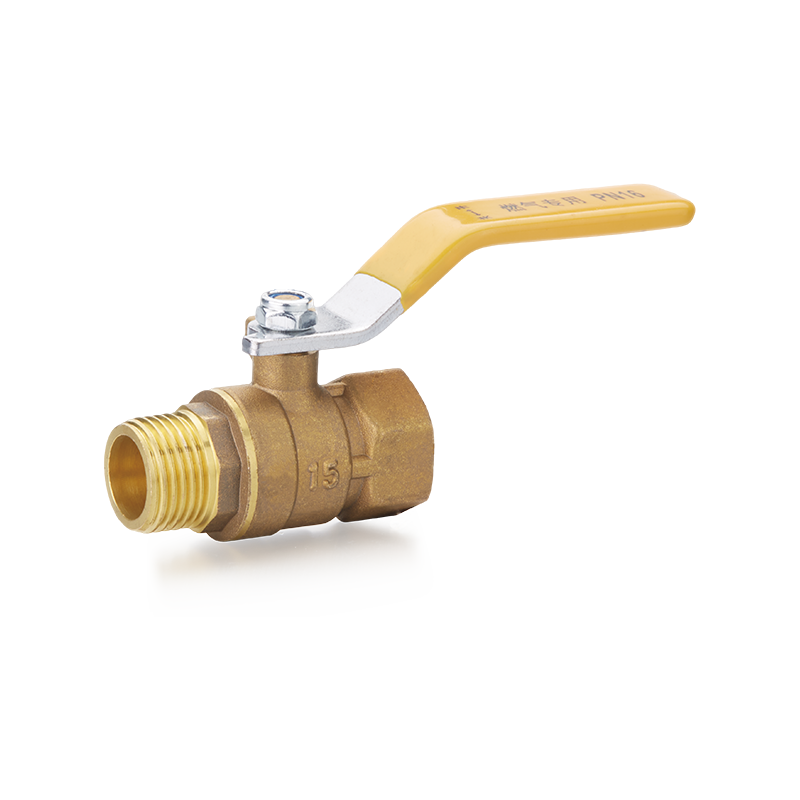
Product: YH-103 Brass Threaded Gate Valve

Related Products
Related News
Contact Us
-

-
 +86-0574-63742169
 -
 No.104-128, Cizhang East Road, Zhangqi Town, Cixi City, Ningbo, Zhejiang Province, China


Message Us Now !
