


 English
  русский
  عربى
عربى  Español
Brass Ball Valve with Base for Stable F/M Pipeline Connections
Content
- 1 Product Overview: A Practical Valve for Flexible Fixed Installations
- 2 Why the F/M Thread Structure Matters
- 3 Integrated Base: A Small Design Feature with Major Installation Value
- 4 Reliable Sealing for Water and Gas Applications
- 5 Brass Construction and Practical Durability
- 6 Competitive Advantages at a Glance
- 7 Application Scenarios
- 8 Manufacturing Strength Behind the Product
- 9 Quality Control from Material to Finished Valve
- 10 Advantages for Distributors, Wholesalers, and Project Buyers
- 11 Installation Considerations
- 12 Maintenance and Long-Term Operation
- 13 How the Product Supports Safer Pipeline Layouts
- 14 Design Value Beyond Basic Shut-Off
- 15 Company Capabilities Supporting Global Fluid Control Needs
- 16 Q&A Section
- 16.1 What is the main purpose of the YH-211 Brass Ball Valve with Base?
- 16.2 What does F/M mean in this valve design?
- 16.3 Why is the integrated base important?
- 16.4 How does this valve compare with ordinary brass ball valves?
- 16.5 Is the valve suitable for water and gas applications?
- 16.6 What sealing advantage does the product offer?
- 16.7 Why is brass a good material for this valve?
- 16.8 How does the manufacturer support product consistency?
- 16.9 What should installers pay attention to during installation?
- 16.10 Who can benefit most from this valve?
- 17 Conclusion
- 18 References
- 19 Product: YH-211 Brass Ball Valve with Base(F/M)
In modern fluid and gas control systems, a valve is never just a small accessory. It is a critical point of control, safety, sealing, and installation stability. The YH-211 Brass Ball Valve with Base, designed with a female-to-male threaded connection structure, responds to several practical needs in residential, commercial, and equipment-side piping layouts. It combines flexible connection capability, stable fixed installation, and reliable sealing performance in one compact valve body.
This product is categorized as a brass ball valve with base, and its core value lies in its practical engineering design. One end adopts a female thread, while the other end uses a male thread, allowing the valve to connect different pipeline ends without unnecessary extra adapters in many installation scenarios. The integrated base gives installers a stable fixing point, helping the pipeline resist vibration, displacement, and daily operating stress. For applications involving tap water, gas, and similar compatible media, the sealing structure is designed to reduce leakage risk and support dependable long-term use.
Compared with ordinary straight brass ball valves, the YH-211 offers a more installation-friendly configuration. Compared with valves that require additional brackets or mounting accessories, its integrated base helps simplify fixed installation. Compared with products that use inconsistent sealing materials or loose machining tolerances, its emphasis on precision manufacturing and high-quality rubber seals supports safer and more durable performance. These advantages are especially important in projects where installation space, vibration control, and connection adaptability must be considered at the same time.
Ningbo Yunhua Valve Co., Ltd. manufactures valves and hardware accessories with a focus on gas and fluid control, water supply valves, and related hardware systems. The company has developed automated precision machining, assembly, and testing capabilities, supported by advanced CNC equipment and professional production management. With a manufacturing site covering approximately 20,000 square meters and an annual production capacity of 2 million sets of valves and 10 million sets of hardware accessories, the company has the scale and technical foundation needed to supply consistent products for domestic and international markets.
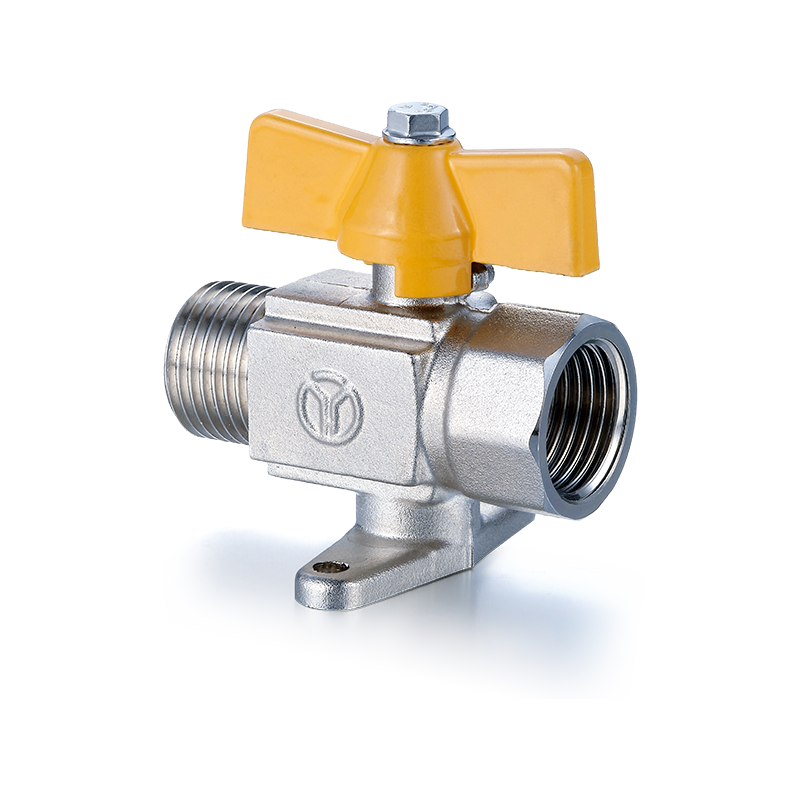
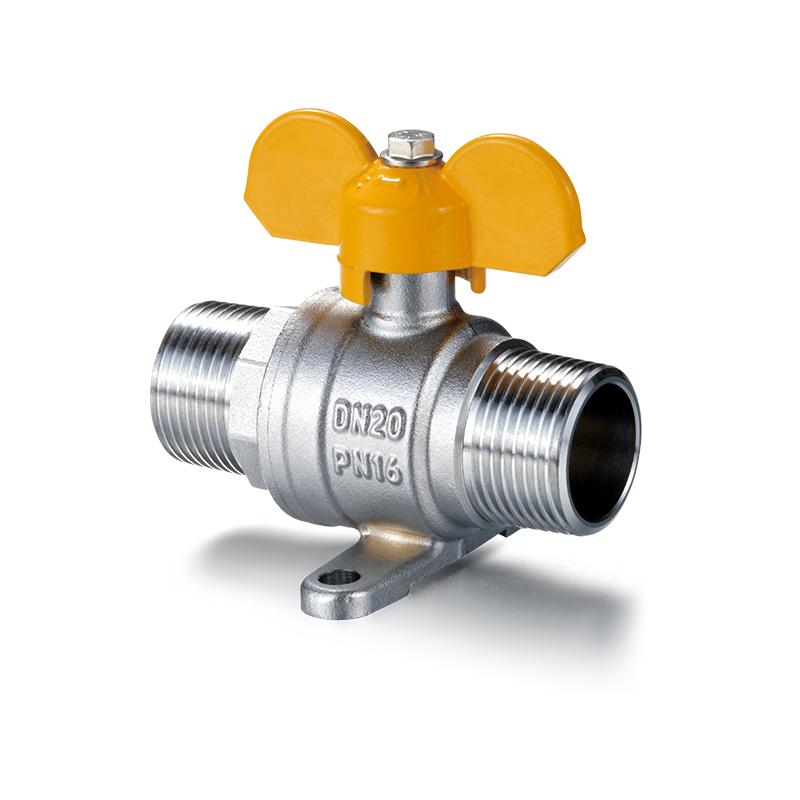
YH-211 Brass Ball Valve with Base(F/M)
Product Overview: A Practical Valve for Flexible Fixed Installations
The YH-211 Brass Ball Valve with Base is designed for pipeline systems that require both shut-off control and stable positioning. Its brass body provides mechanical strength and corrosion resistance suitable for many standard water and gas-related applications. Its ball valve structure allows quick opening and closing, while the handle offers intuitive manual operation. The addition of a base is a key feature because it enables fixed mounting on walls, panels, equipment frames, or other suitable surfaces.
The F/M design means that the valve includes one female threaded end and one male threaded end. This partial male and female thread structure is especially useful in branch connection and transition connection scenarios. In real-world piping systems, not every connection point has the same thread form or installation direction. A valve with both thread types can reduce the need for additional fittings, shorten installation time, and make the pipeline layout cleaner.
The integrated base is another major feature. In many installations, ordinary valves are supported only by the pipes connected to them. Over time, pipeline vibration, water hammer, equipment movement, or repeated manual operation can create stress at the threaded joints. A mounting base helps transfer some of this stress to a fixed surface, reducing the likelihood of displacement and improving the overall stability of the pipeline system.
The sealing performance of the valve is also central to its value. The valve seat is configured with rubber seals selected for wear resistance and air tightness. In a valve used for tap water, gas, or similar compatible media, sealing quality is directly related to safety, efficiency, and user confidence. A small leakage point can cause water waste, gas safety risk, operational interruption, or maintenance costs. The YH-211 addresses this concern through a structure designed for dependable closure and long-term service.
Why the F/M Thread Structure Matters
Threaded valves are widely used because they are convenient, compact, and suitable for many medium- and low-pressure pipeline applications. However, ordinary valves often use the same thread type on both ends, such as female-to-female or male-to-male. While these designs are useful, they may require additional adapters when connecting pipelines of different configurations. Each added adapter creates another joint, and each joint becomes another potential leakage point.
The YH-211 uses a female thread on one side and a male thread on the other side. This arrangement gives installers greater flexibility when adapting to existing pipeline layouts. In a renovation project, for example, one end of the existing system may already be prepared for a male-threaded valve connection, while the other side may require a male outlet. A valve with both female and male threads can solve this mismatch more directly.
In branch connection scenarios, a pipeline may need to divide flow toward an appliance, fixture, meter, or equipment inlet. Space may be limited, and the direction of the connection may not allow the use of multiple adapters. A compact F/M valve can reduce connection length and make the installed system neater. In transition connection scenarios, it can serve as both a shut-off valve and a connector between two differently configured pipe ends.
Another benefit is maintenance convenience. When a pipeline component must be replaced, a valve that matches the thread structure of nearby components can reduce disassembly complexity. Installers can isolate flow, remove sections more efficiently, and reinstall with fewer parts. In commercial or residential maintenance work, reducing service time is a real advantage.
Competitor products that rely only on one thread configuration may still perform well in standard layouts, but they often require extra parts when the installation conditions are not ideal. Those extra parts add cost, increase inventory requirements, lengthen installation time, and may affect the visual cleanliness of the final pipeline arrangement. The F/M design of the YH-211 provides a more adaptable option for practical field conditions.
Integrated Base: A Small Design Feature with Major Installation Value
The base is one of the most important differentiators of the YH-211. A ball valve without a fixed base depends on the pipeline for support. This may be acceptable in simple straight-line installations, but it can become problematic where the valve is located near equipment, on a wall, under a sink, near a meter, or in a position where people frequently operate the handle.
Every time a handle is turned, force is applied to the valve body. If the valve is unsupported, that force may transfer to the connected pipes and threaded joints. Over many operating cycles, this may loosen connections, especially if the piping is exposed to vibration. In water systems, pressure fluctuation can also create repeated mechanical stress. In gas systems, any unnecessary stress at joints should be minimized because sealing reliability is essential.
The integrated base provides a fixing platform. Once mounted properly, the valve is held in position, reducing swinging, rotation, and displacement. This is especially valuable for indoor wall-hung pipelines, equipment-side connections, cabinet installations, and locations where pipes must remain neatly aligned. A stable valve is also easier to operate because the user can turn the handle without feeling the entire pipeline shift.
Compared with competitor valves that require separate brackets, the integrated base offers a cleaner and more compact solution. Separate brackets may be useful, but they require additional purchasing, matching, drilling, and installation steps. A built-in base reduces these steps and ensures that the fixing point is aligned with the valve body from the beginning. This helps installers save time while improving consistency across multiple installations.
In multi-unit projects, such as residential developments, commercial water systems, equipment assemblies, or OEM installations, installation repeatability matters. A valve with a built-in base can help standardize mounting practices. Standardization reduces training time, improves installation appearance, and supports predictable quality inspection.
Reliable Sealing for Water and Gas Applications
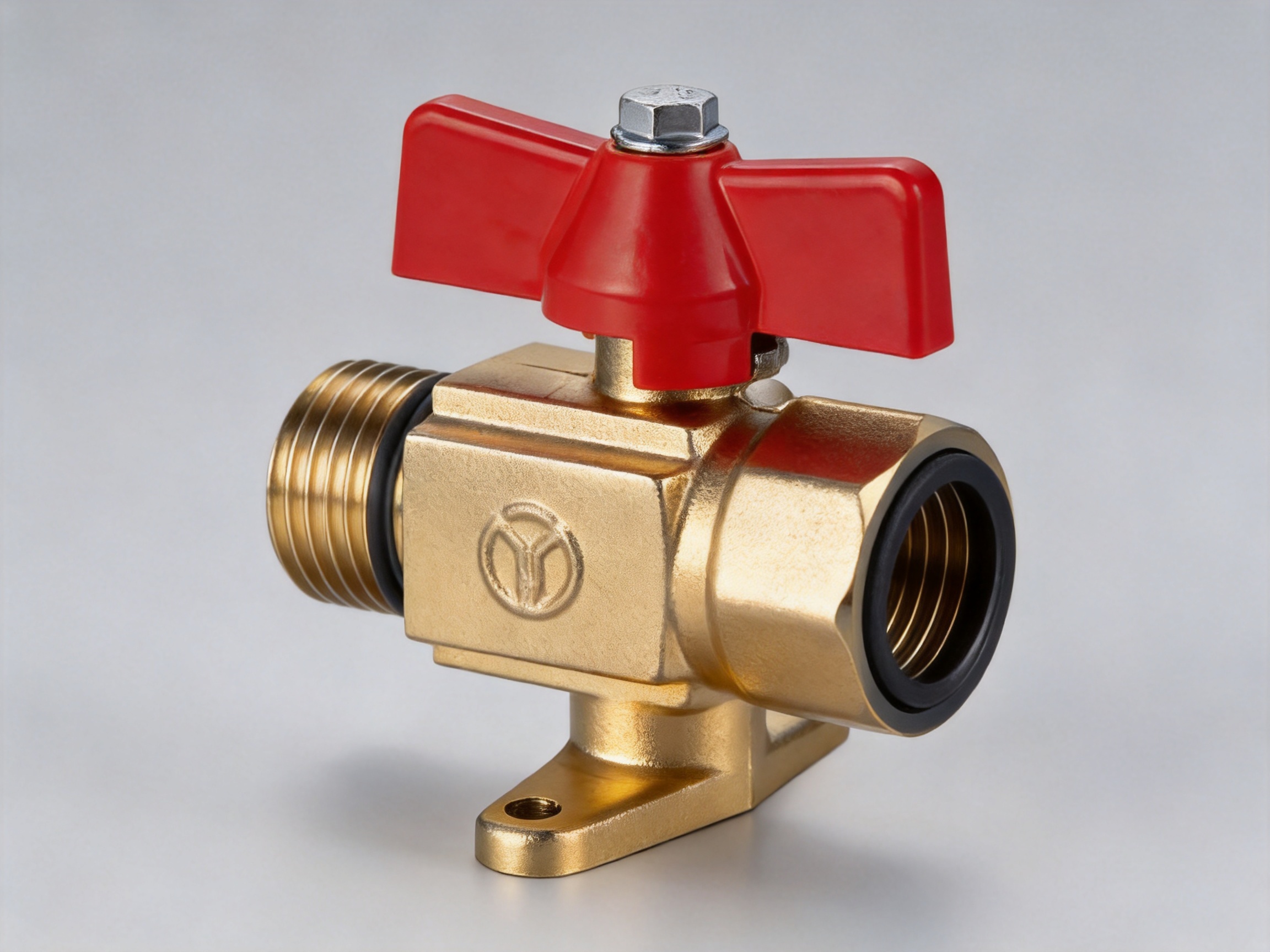
Sealing is the foundation of valve performance. A valve may look strong, but if it cannot seal reliably, it cannot serve its purpose. The YH-211 is designed with high-quality rubber seals in the valve seat area. These seals contribute to air tightness, wear resistance, and stable closure performance. For compatible media such as tap water and gas, this sealing design helps prevent leakage during normal use.
Ball valves work by rotating a drilled ball inside the valve body. When the hole in the ball aligns with the pipeline, flow passes through. When the handle turns the ball ninety degrees, the solid side of the ball blocks flow. This simple quarter-turn operation is one reason ball valves are popular. However, the quality of the seal between the ball and the valve seat determines whether shut-off performance is dependable.
Wear resistance is important because the ball rotates against the seat during operation. If the seal material deforms, cracks, or wears too quickly, the valve may begin to leak internally. Air tightness is especially important for gas service. Even very small leakage can create safety concerns. Therefore, proper sealing material selection and careful assembly are essential.
Competitor products may use lower-grade seals, inconsistent seat dimensions, or less controlled assembly methods. These problems may not be obvious when a valve is new, but they can become apparent after repeated use. The YH-211 is positioned as a product that emphasizes leakage prevention, reliable operation, and durability.
Good sealing also depends on machining accuracy. If the brass body, ball surface, threads, or seat positioning are not manufactured consistently, even good seal materials may not perform properly. This is where the manufacturer’s production capability becomes important. Precision CNC machining, controlled assembly, and testing processes help ensure that the sealing system is not merely designed well but also produced consistently.
Brass Construction and Practical Durability
Brass is widely used in valves because it offers a useful combination of strength, machinability, corrosion resistance, and cost efficiency. For many water supply and gas control applications, brass valves provide long service life when properly designed and installed. The YH-211 benefits from these material characteristics while adding the structural advantage of an integrated base.
One major advantage of brass is dimensional stability during machining. Brass can be processed to accurate thread forms and sealing surfaces, which is essential for threaded valves. Clean threads improve installation efficiency and help create tight connections when used with proper sealing methods. Smooth internal surfaces can also support stable flow and reduce unnecessary turbulence.
Brass also resists many forms of corrosion that affect ordinary steel in water-related environments. While no material is suitable for every medium, brass is a proven choice for many plumbing, fluid control, and hardware accessory applications. For buyers and installers, brass provides confidence because it is familiar, widely accepted, and supported by established installation practices.
Compared with plastic valves, brass valves usually offer higher mechanical strength and better resistance to impact and thread damage. Plastic valves can be lightweight and economical, but they may not provide the same robustness in threaded installations or equipment-side locations where mechanical stress occurs. Compared with some iron or steel valves, brass valves may offer better corrosion resistance in many common water applications and are often easier to install in compact systems.
The YH-211 is therefore suitable for projects where durability, connection reliability, and installation stability are more important than simply choosing the lowest-cost component. For professional buyers, the total cost of ownership includes installation labor, leakage risk, maintenance frequency, replacement costs, and user satisfaction. A well-designed brass valve can reduce these hidden costs.
Competitive Advantages at a Glance
The following table summarizes how the YH-211 Brass Ball Valve with Base compares with common alternatives in the market. The purpose is not to claim that one valve type is suitable for every application, but to show where this product provides clear practical advantages.
| Comparison Factor | YH-211 Brass Ball Valve with Base | Ordinary Brass Ball Valve | Valve with Separate Bracket | Basic Low-Cost Valve |
|---|---|---|---|---|
| Connection Flexibility | Female and male thread design supports transition and branch connections | Often limited to same-thread connection types | Depends on valve thread configuration | Usually limited and may require adapters |
| Installation Stability | Integrated base helps resist vibration and displacement | Usually supported mainly by pipes | Can be stable but requires extra bracket selection and installation | Often lacks stable fixing features |
| Leakage Prevention | High-quality rubber seals and controlled manufacturing support reliable sealing | Performance varies by design and production quality | Depends on valve quality | May use lower-grade sealing components |
| Installation Efficiency | Reduces need for extra adapters and mounting accessories in many cases | May need adapters or additional supports | Requires separate mounting steps | May appear simple but can create extra work during installation |
| Long-Term Use | Designed for stable operation in fixed installations | May loosen if exposed to vibration or frequent operation | Good if bracket is correctly selected and installed | Higher risk of early wear or leakage |
This comparison highlights the main value of the product: it is not only a shut-off valve, but also a connection and installation solution. By combining a brass body, F/M threading, integrated base, and reliable sealing, it addresses several common problems that installers experience in real projects.
Application Scenarios
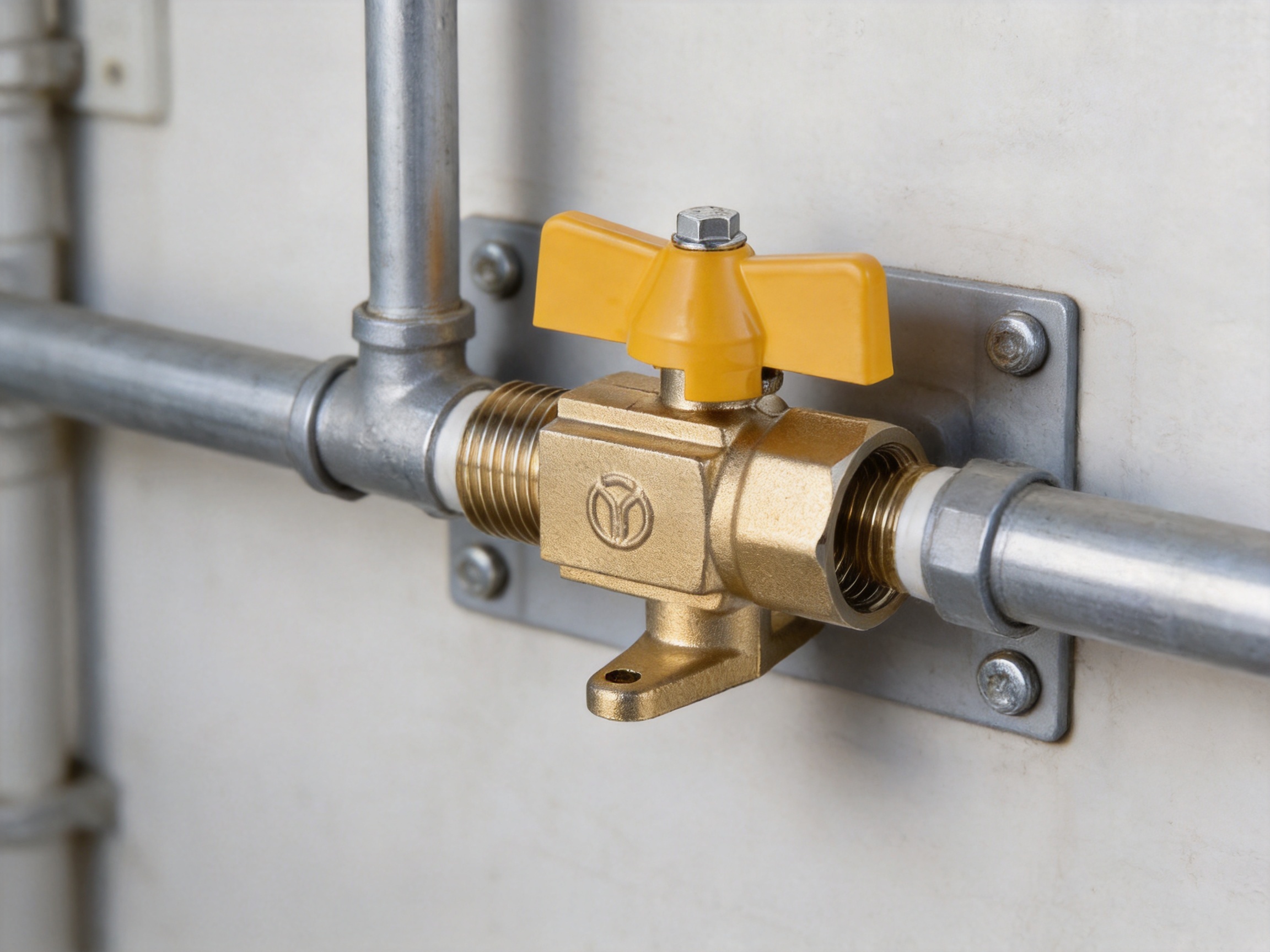
The YH-211 is suitable for many fixed installation scenarios where a compact, threaded brass valve is needed. Its design is especially relevant for indoor wall-hung pipelines, equipment-side connections, transition sections, branch connections, water supply lines, and compatible gas systems. The base makes it particularly useful in positions where the valve must remain aligned and easy to operate.
In residential water supply systems, valves are often installed under sinks, near water heaters, around meters, or along wall-mounted pipe sections. A base-mounted valve can help maintain order in these spaces. It can also make future maintenance more convenient because the valve remains fixed while connected parts are serviced.
In gas pipeline layouts, stable installation and leakage prevention are especially important. While actual use must always comply with local standards, installation rules, and medium compatibility requirements, the valve’s sealing design and fixed base are beneficial characteristics for gas-related applications. The female-to-male connection may also simplify transitions between existing fittings and appliance-side connections.
In equipment-side installations, vibration can be a concern. Pumps, compressors, water treatment units, heating equipment, laboratory devices, and small industrial systems may generate movement during operation. A valve mounted with a base is better positioned to resist repeated vibration than a valve supported only by the pipeline. This helps protect threaded connections and improves the professional appearance of the installation.
In branch connection applications, a valve may be installed to control flow to a secondary line. The F/M design can reduce the number of fittings required in these layouts. Fewer fittings may mean fewer joints, reduced installation space, lower material cost, and improved sealing reliability.
Manufacturing Strength Behind the Product
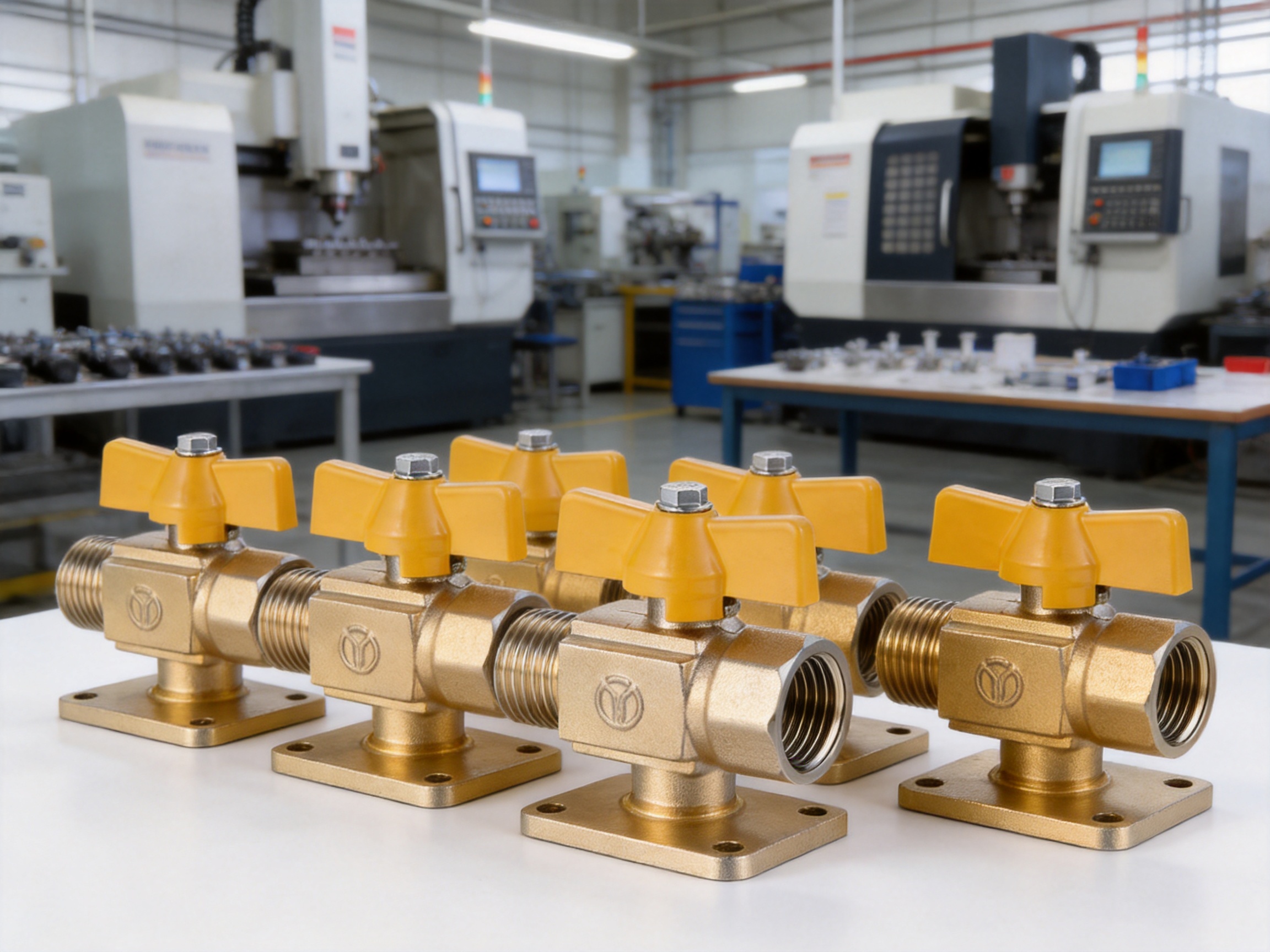
A valve’s performance depends not only on its design but also on how consistently that design is manufactured. Ningbo Yunhua Valve Co., Ltd. has developed manufacturing strengths that support reliable production of valves and hardware accessories. The company specializes in gas and fluid valves, water supply valves, and related hardware products, giving it practical industry experience across multiple application categories.
The company operates on a site of approximately 20,000 square meters. This production scale allows it to organize machining, assembly, inspection, warehousing, and logistics in a structured way. A well-planned manufacturing environment is important because valve production requires consistent material handling, dimensional control, cleanliness, assembly accuracy, and final testing.
One of the company’s important strengths is its professional automated precision machining workshop. Brass valve bodies and components require accurate machining of threads, sealing surfaces, ball chambers, and mounting features. Automated precision machining helps reduce variation between parts, improve production efficiency, and support repeatable quality. In valve manufacturing, small dimensional deviations can affect sealing, assembly torque, thread fit, and handle operation.
The company is equipped with advanced domestic and international CNC machine tools. CNC machining is essential for producing consistent valve components at scale. It allows complex features to be manufactured according to controlled programs, reducing the variability that can occur with manual processing. For a product such as the YH-211, this capability supports accurate F/M thread formation, stable base geometry, and precise internal valve body dimensions.
In addition to machining, the company has automated assembly and testing equipment. Assembly quality is critical for ball valves because the relationship between the ball, seals, stem, handle, and body determines operating feel and leakage performance. Automated or professionally controlled assembly helps maintain consistency in seat placement, component alignment, tightening force, and final inspection.
Testing is equally important. A valve should be checked before it reaches the customer. Professional testing equipment can verify sealing performance, operational reliability, and conformance to relevant requirements. While specific testing parameters depend on the product standard and customer application, the existence of dedicated testing capability demonstrates a commitment to quality control rather than relying only on visual inspection.
The company has an annual production capacity of approximately 2 million sets of valves and 10 million sets of hardware accessories. This capacity matters to distributors, wholesalers, project buyers, and OEM customers because supply stability is a major purchasing concern. A supplier must be able to provide not only a good sample but also consistent batch delivery. Production scale, automated processes, and structured management help support large-volume orders while maintaining quality expectations.
Quality Control from Material to Finished Valve
Quality control for a brass ball valve begins before machining. Material selection and incoming inspection are important because the brass body must have suitable mechanical and processing properties. If raw material quality is inconsistent, machining accuracy and final product reliability may suffer. A professional valve manufacturer must manage material sourcing carefully and maintain inspection standards for critical inputs.
During machining, dimensional accuracy is checked through process controls. Thread dimensions, sealing cavities, stem holes, base mounting features, and surface finishes all influence final performance. For the YH-211, the F/M threads must connect smoothly with matching pipe components. The integrated base must be formed accurately so that it sits properly during installation. The internal ball and seat area must be processed with precision to support tight shut-off.
After machining, components move to assembly. At this stage, seals are installed, the ball is positioned, the stem and handle are fitted, and the valve is tightened according to controlled procedures. Consistency is vital. If the assembly is too loose, leakage may occur. If it is too tight, operation may become difficult or seals may be damaged. Professional assembly processes help balance sealing force and smooth handle movement.
Testing provides final confirmation. Leakage testing, pressure-related checks, and functional operation checks can identify defects before shipment. A valve intended for water or gas applications must inspire confidence, and that confidence comes from systematic control at every production stage. This is where advanced manufacturing processes give the YH-211 an advantage over competitors that rely on less controlled production methods.
Packaging and logistics also affect quality. Threads and sealing surfaces should be protected from damage during handling and transportation. Clear product identification and organized packing support efficient distribution and reduce the risk of incorrect product selection at the installation site.
Advantages for Distributors, Wholesalers, and Project Buyers
For distributors and wholesalers, a valve must be marketable, reliable, and easy to explain to customers. The YH-211 has clear selling points: flexible F/M connection, integrated base, brass construction, and leak-proof sealing design. These are not abstract features; they solve problems that installers understand immediately. A product that can be explained clearly is easier to promote across plumbing, hardware, gas fitting, and equipment accessory channels.
For project buyers, standardization and reliability are essential. When hundreds or thousands of valves are installed across a development or facility, even small failure rates can create major service costs. A valve that supports stable mounting and reduces joint complexity can help improve project installation quality. The integrated base also supports uniform installation appearance, which matters in visible utility areas and equipment rooms.
For OEM customers, manufacturing capability is important. A supplier with automated machining, assembly, and testing capacity can better support consistent specifications and repeat orders. The company’s production capacity provides confidence for buyers who need both volume and quality stability. In competitive supply chains, the ability to deliver consistent products on schedule can be as important as the product design itself.
For maintenance professionals, the valve’s features reduce practical difficulties. A fixed valve is easier to operate and less likely to move during service. The F/M design may simplify replacement in mixed-thread systems. Reliable sealing reduces callbacks, which saves time and protects professional reputation.
Installation Considerations
Correct installation is essential for any valve. Even a well-made valve can fail if it is installed incorrectly. Before installing the YH-211, the installer should verify thread compatibility, medium compatibility, pressure conditions, temperature conditions, and local code requirements. The valve should be used only in applications suitable for its material and design.
The pipeline should be clean before installation. Dirt, metal chips, sealing tape fragments, or other debris may enter the valve and affect sealing surfaces. Cleaning the pipe ends helps protect the ball and seat. The threads should also be inspected to ensure they are not damaged or contaminated.
When connecting threaded ends, proper sealing materials should be used according to local practice and the medium being transported. The installer should avoid excessive sealant that could enter the valve body. Over-tightening should also be avoided because excessive torque may damage threads or stress the valve body. A secure connection is necessary, but more force is not always better.
The integrated base should be fixed to a suitable surface using appropriate fasteners. The mounting surface should be strong enough to support the valve and resist vibration. The installer should align the valve carefully before tightening fasteners and pipe connections. Proper alignment helps reduce stress on the threaded joints.
After installation, the system should be tested according to applicable requirements. The valve should be operated to confirm smooth opening and closing. The connection points and valve body should be checked for leakage. For gas-related applications, leak testing must be performed with approved methods and by qualified personnel where required.
Maintenance and Long-Term Operation
Ball valves are known for low maintenance, but periodic inspection is still recommended. The YH-211 should be checked for leakage, handle condition, mounting stability, and visible corrosion or damage. In fixed installations, the base fasteners should remain secure. If vibration is present, periodic inspection becomes even more important.
The valve should be operated occasionally if the system allows. Valves that remain in one position for long periods may become harder to turn due to deposits or environmental factors. Periodic operation can help maintain movement, although it should always be done safely and in accordance with system requirements.
If leakage is detected at the threaded connection, the system should be depressurized before any repair work. The joint may need to be resealed or reinstalled. If leakage occurs through the valve when closed, the internal sealing components may be worn or contaminated, and replacement may be necessary depending on the product design and maintenance policy.
The valve should not be used as a structural support for unrelated pipeline loads. Although the integrated base improves stability, proper pipe support is still important. The base helps fix the valve, but the piping system should be designed to avoid excessive stress, misalignment, or vibration.
Long-term performance depends on correct selection, correct installation, suitable media, and proper inspection. When these conditions are met, a brass ball valve with a stable base can provide dependable service and reduce maintenance concerns.
How the Product Supports Safer Pipeline Layouts
Safety in pipeline systems comes from multiple layers: suitable materials, secure connections, reliable sealing, stable installation, and professional testing. The YH-211 contributes to each of these areas. Its brass body provides mechanical reliability. Its F/M thread structure supports direct connection in transition layouts. Its integrated base helps prevent movement. Its rubber sealing configuration supports leak-proof performance.
In gas applications, reducing unnecessary joints is particularly valuable. Every threaded joint must be properly sealed and inspected. If the F/M design eliminates an adapter in a specific installation, it also eliminates an additional joint. This can improve installation simplicity and may reduce leakage risk when installed correctly.
In water supply applications, stable mounting helps prevent damage from repeated use. A valve under a sink or near equipment may be operated many times during maintenance. If the valve moves each time, connected joints may gradually loosen. A fixed base helps keep the valve steady, protecting the surrounding pipeline.
In equipment-side applications, vibration can create fatigue over time. A base-mounted valve is not a substitute for complete vibration control, but it is a valuable part of a stable installation strategy. Combined with proper pipe supports, flexible connectors where needed, and correct fastening, the valve can contribute to a safer and more reliable system.
Design Value Beyond Basic Shut-Off
Many buyers evaluate valves mainly by size, thread type, and price. While these factors matter, they do not capture the full value of a product like the YH-211. This valve offers value beyond basic shut-off because it improves installation adaptability and stability. These features can reduce hidden costs that appear during installation and maintenance.
For example, if a standard valve requires two extra adapters, the apparent low price of the valve may be offset by the cost of fittings and labor. If an unsupported valve later loosens due to vibration, maintenance costs may exceed the initial savings. If poor sealing causes leakage, the consequences may include water damage, gas safety concerns, downtime, or customer dissatisfaction.
The YH-211 is designed to address these real-world cost factors. Its F/M structure can reduce fitting complexity. Its base can reduce movement. Its sealing design can reduce leakage risk. Its brass construction can support durability. Its manufacturing background provides confidence in consistency.
For professional buyers, this means the valve should be evaluated as part of the total pipeline system, not as an isolated component. A slightly more functional valve may deliver better overall value if it saves labor, reduces leakage risk, and improves long-term stability.
Company Capabilities Supporting Global Fluid Control Needs
Ningbo Yunhua Valve Co., Ltd. has positioned itself as an innovative enterprise serving gas and fluid valves, water supply valves, and hardware accessories. Over more than ten years of development, the company has cultivated its corporate culture, improved its management system, and established a professional management team. These organizational strengths support consistent product development and production execution.
The company’s vision is to become a leading company in the global fluid control industry, and its mission is to build a safe fluid ecosystem with high-quality valves. These goals align with the practical requirements of products such as the YH-211. A safe fluid ecosystem depends on components that seal reliably, install securely, and perform consistently over time.
Advanced CNC machine tools, automated assembly lines, and testing workshops are not merely production assets; they are quality assurance tools. They allow the company to control the details that matter in valve performance. Threaded globe valves, forged steel valves, brass gas ball valves, water supply valves, and hardware accessories all require disciplined manufacturing processes. Experience across these categories strengthens the company’s understanding of fluid control systems and customer expectations.
For international buyers, manufacturing strength must be paired with communication, service, and customization capability. A company with broad production capacity and a specialized management team is better positioned to respond to order requirements, technical discussions, packaging needs, and quality expectations. The YH-211 benefits from this background because it is produced within a larger system focused on valve reliability and hardware accessory excellence.
Q&A Section
What is the main purpose of the YH-211 Brass Ball Valve with Base?
The main purpose of the YH-211 is to provide reliable shut-off control while also supporting stable fixed installation. It is designed for pipeline systems where connection flexibility, leak prevention, and mounting stability are important.
What does F/M mean in this valve design?
F/M means female-to-male. One end of the valve uses a female thread, and the other end uses a male thread. This structure helps connect different pipeline ends and is useful in branch connection and transition connection scenarios.
Why is the integrated base important?
The integrated base allows the valve to be fixed to a wall, panel, equipment frame, or other suitable surface. This helps resist vibration, displacement, and stress caused by handle operation or pipeline movement.
How does this valve compare with ordinary brass ball valves?
Ordinary brass ball valves may provide basic shut-off control, but many do not include an integrated base or F/M thread structure. The YH-211 offers better installation adaptability and stability, reducing the need for extra adapters or separate brackets in many situations.
Is the valve suitable for water and gas applications?
The valve is designed for compatible media such as tap water and gas-related applications, subject to proper selection, installation, and local regulatory requirements. Installers should always confirm suitability for the specific medium, pressure, temperature, and code conditions.
What sealing advantage does the product offer?
The valve seat uses high-quality rubber seals designed for wear resistance and air tightness. This supports reliable sealing and helps prevent leakage during normal long-term operation.
Why is brass a good material for this valve?
Brass offers strength, machinability, corrosion resistance in many common applications, and reliable thread-forming characteristics. These properties make it a widely used material for water supply valves, gas valves, and hardware accessories.
How does the manufacturer support product consistency?
Ningbo Yunhua Valve Co., Ltd. supports product consistency through automated precision machining, CNC machine tools, automated assembly equipment, and professional testing workshops. These processes help control dimensional accuracy, assembly quality, and sealing performance.
What should installers pay attention to during installation?
Installers should confirm thread compatibility, clean the pipeline, use suitable thread sealing materials, avoid over-tightening, fix the base securely, align the valve properly, and test the system for leakage after installation.
Who can benefit most from this valve?
Installers, maintenance professionals, distributors, wholesalers, project buyers, and OEM customers can benefit from the valve’s combination of flexible connection, stable mounting, brass durability, and reliable sealing performance.
Conclusion
The YH-211 Brass Ball Valve with Base is a practical and well-focused product for pipeline systems that require more than simple flow shut-off. Its F/M threaded structure improves connection flexibility, especially in branch and transition layouts. Its integrated base supports stable fixed installation, reducing movement caused by vibration, pipeline stress, and repeated operation. Its sealing design, supported by high-quality rubber seals, helps prevent leakage in compatible water and gas-related applications.
Compared with ordinary valves, the product offers clear advantages in adaptability, stability, and installation efficiency. Compared with low-cost alternatives, it provides stronger long-term value through brass construction, controlled sealing performance, and a more complete installation-oriented design. Compared with valves that require separate brackets, its integrated base simplifies mounting and improves consistency.
The manufacturing strength behind the product further reinforces its value. Ningbo Yunhua Valve Co., Ltd. operates advanced machining, assembly, and testing facilities, supported by CNC equipment, automated production processes, and significant annual capacity. These capabilities help transform a strong design into a reliable product suitable for professional supply chains and demanding installation environments.
For buyers seeking a brass gas ball valve or water-compatible threaded ball valve with better installation stability, the YH-211 represents a strong option. It reflects the direction of modern valve design: compact, adaptable, stable, leak-resistant, and manufactured with consistent industrial discipline.
References
Crane Co. Flow of Fluids Through Valves, Fittings, and Pipe. Technical Paper No. 410.
American Society of Mechanical Engineers. ASME B1.20.1: Pipe Threads, General Purpose.
International Organization for Standardization. ISO 7-1: Pipe Threads Where Pressure-Tight Joints Are Made on the Threads.
Manufacturers Standardization Society. MSS SP-110: Ball Valves Threaded, Socket-Welding, Solder Joint, Grooved and Flared Ends.
British Standards Institution. BS EN 13828: Building Valves, Manually Operated Copper Alloy and Stainless Steel Ball Valves for Potable Water Supply in Buildings.
American Water Works Association. Manual of Water Supply Practices: Distribution Valves.
Product: YH-211 Brass Ball Valve with Base(F/M)

Related Products
Related News
Contact Us
-

-
 +86-0574-63742169
 -
 No.104-128, Cizhang East Road, Zhangqi Town, Cixi City, Ningbo, Zhejiang Province, China


Message Us Now !
